🎶 Start your 14-day free trial & unlock the full course today. Start Free Trial →
tonebase Piano Course

Chopin

Scherzo No. 3 in C-sharp Minor, Op. 39

Taught by renowned instructor

Garrick Ohlsson

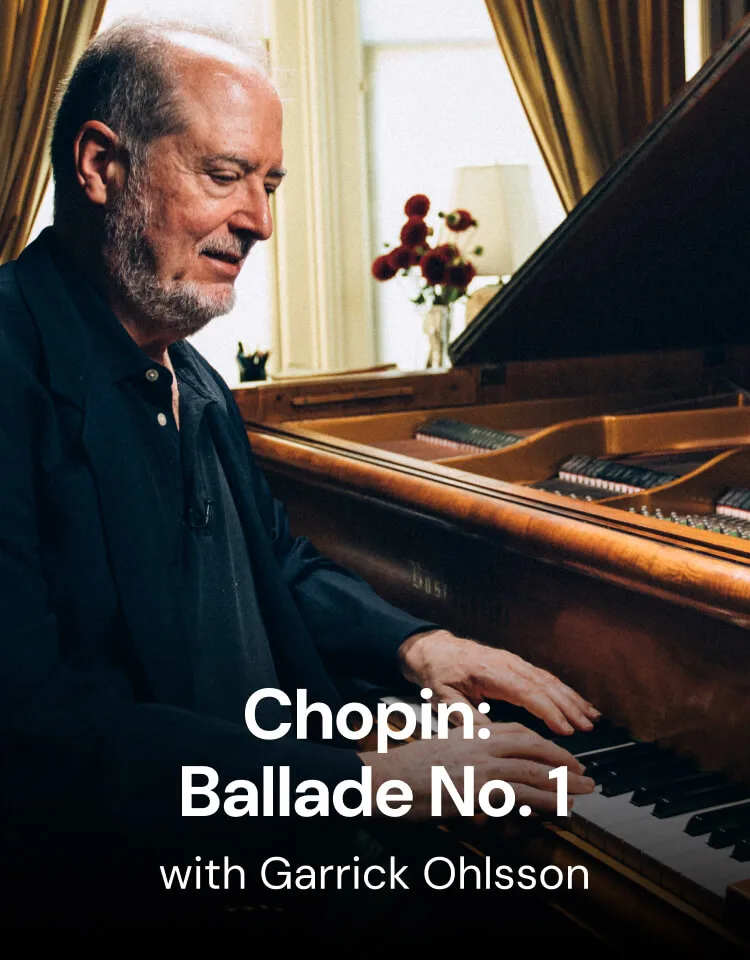
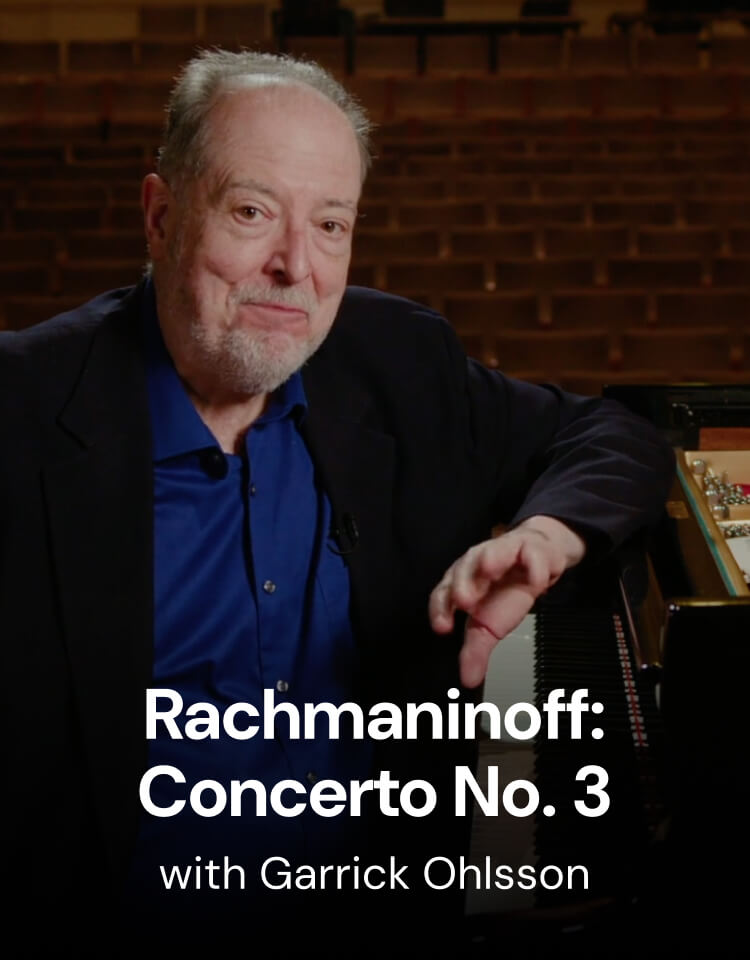
In this lesson, American pianist Garrick Ohlsson guides you through Chopin’s Scherzo, Op. 39, No. 3 in C-sharp Minor. <br><br>When you practice the introduction, Ohlsson encourages you to explore playing with different degrees of rubato, since pianists have interpreted this section in numerous different ways, and Chopin does not specify tempo markings. <br><br>When you practice the octaves in this piece, Ohlsson suggests using the lateral movement of your thumb to help you to reach wide intervals without needlessly shifting your entire hand position. To find even more comfort, you will learn to cultivate a “relaxation response,” immediately releasing tension in your hand after striking the keyboard. <br><br>You will also learn strategies for practicing Chopin’s challenging left-hand jumps. To avoid locking your hands at either end of a jump, Ohlsson teaches you to imagine each jump as a single, fluid gesture in which your arm is constantly oscillating.

  • checkmark icon
    Difficulty: 
    Advanced
  • checkmark icon
    Duration: 
    1
     hours
     hour
All courses on tonebase include subtitles in English and Spanish

Course Syllabus

Scherzo No. 3 in C-sharp Minor, Op. 39

In this lesson, American pianist Garrick Ohlsson guides you through Chopin’s Scherzo, Op. 39, No. 3 in C-sharp Minor.

When you practice the introduction, Ohlsson encourages you to explore playing with different degrees of rubato, since pianists have interpreted this section in numerous different ways, and Chopin does not specify tempo markings.

When you practice the octaves in this piece, Ohlsson suggests using the lateral movement of your thumb to help you to reach wide intervals without needlessly shifting your entire hand position. To find even more comfort, you will learn to cultivate a “relaxation response,” immediately releasing tension in your hand after striking the keyboard.

You will also learn strategies for practicing Chopin’s challenging left-hand jumps. To avoid locking your hands at either end of a jump, Ohlsson teaches you to imagine each jump as a single, fluid gesture in which your arm is constantly oscillating.

On Touch

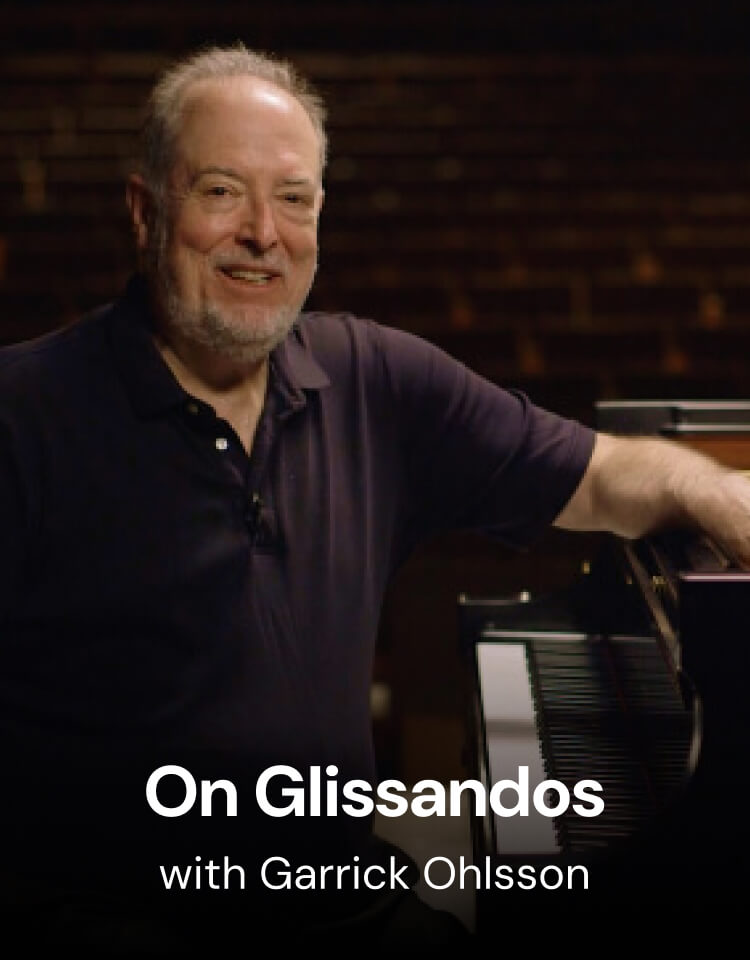
In this lesson, American pianist Garrick Ohlsson discusses touch, which he describes as an “ecology” of interactions among different variables of sound and intent, or, in more technical terms, the regulation of pressure applied to the keys.

The art of touch, Ohlsson explains, is grounded in the act of fooling the ear. He describes the piano as “a box of decrescendos.” Its sound, after all, immediately decays. Whenever you execute crescendos or a cantabile style of playing at the piano, you are in fact creating an illusion, because it is ultimately impossible to control a note’s dynamic level once a key is depressed.

Ohlsson also introduces you to his notion of the “relaxation response.” You will discover the importance of immediately releasing physical tension after striking a note. Ohlsson invites you to think of your hand as a muscle; a beating heart that must expand after contraction. This advice is particularly helpful to bear in mind when pursuing a legato style; a connected sound, you learn, does not require you to hold onto notes unnecessarily.

Click here to download the course workbook PDF and see the full syllabus →
Access this course and hundreds more.

Click below to access hundreds of exclusive piano courses, available only on tonebase.

Unlock Course →
Garrick Ohlsson
meet YOUR INSTRUCTOR

Garrick Ohlsson

Since his triumph as winner of the 1970 Chopin International Piano Competition, pianist Garrick Ohlsson has established himself worldwide as a musician of magisterial interpretive and technical prowess.

read full bio →
Garrick Ohlsson

Learn from legendary pianists

Explore 1,000+ in-depth lessons taught by GRAMMY winners, Juilliard professors, and world-renowned performers, covering everything from timeless repertoire to advanced technique and artistry.

Listen to a few tonebase stories. Ready to start yours?