🎶 Start your 14-day free trial & unlock the full course today. Start Free Trial →
tonebase Piano Course

Liszt

9 Practice Tips on Liszt's Feux Follets

Taught by renowned instructor

Jeffrey Biegel

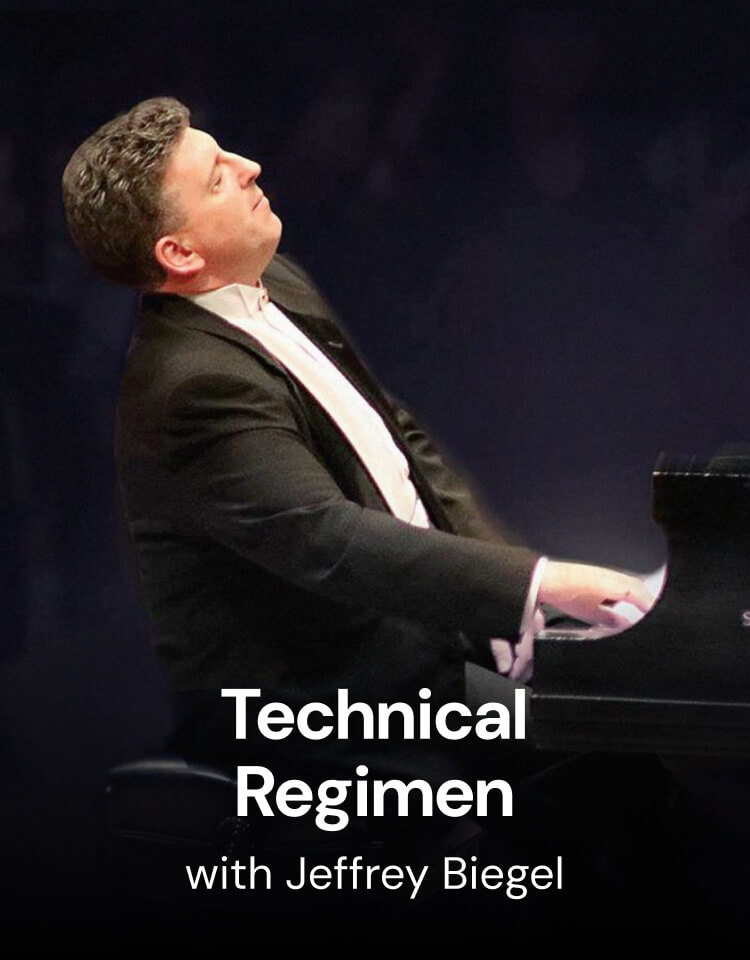
In this bite-sized lesson, American pianist Jeffrey Biegel shares nine concise and practical tips on Liszt’s fiendishly difficult etude “Feux Follets,” or “will-o’-the-wisp.” These essential practice methods make studying this piece far less daunting and lead to fluid and crystal-clear playing.<br><br>Biegel's advice focuses on the infamous double notes that resurface throughout the piece, offering many insights from his studies with Adele Marcus, famous Juilliard professor of the late 20th century and herself a student of the legendary Josef Lhevinne.<br><br>In addition to remarks on fingering and use of the wrist, Biegel comes up with many ways to create variety in your double-note practice: keeping the upper voice legato while playing the lower voice staccato; shifting the accent pattern to emphasize the second note of each group; and, importantly, playing in many different rhythms – Biegel shares eight options!<br><br>Other key insights include exaggerating left-hand leaps, Josef Lhevinne’s sparkling pedaling and “4 Speeds” concept, strongly emphasizing the upper voice in slow practice, stopping after landing a jump, and the powerful add-a-note method.

  • checkmark icon
    Difficulty: 
    Advanced
  • checkmark icon
    Duration: 
    1
     hours
     hour
All courses on tonebase include subtitles in English and Spanish

Course Syllabus

9 Practice Tips on Liszt's Feux Follets

In this bite-sized lesson, American pianist Jeffrey Biegel shares nine concise and practical tips on Liszt’s fiendishly difficult etude “Feux Follets,” or “will-o’-the-wisp.” These essential practice methods make studying this piece far less daunting and lead to fluid and crystal-clear playing.

Biegel's advice focuses on the infamous double notes that resurface throughout the piece, offering many insights from his studies with Adele Marcus, famous Juilliard professor of the late 20th century and herself a student of the legendary Josef Lhevinne.

In addition to remarks on fingering and use of the wrist, Biegel comes up with many ways to create variety in your double-note practice: keeping the upper voice legato while playing the lower voice staccato; shifting the accent pattern to emphasize the second note of each group; and, importantly, playing in many different rhythms – Biegel shares eight options!

Other key insights include exaggerating left-hand leaps, Josef Lhevinne’s sparkling pedaling and “4 Speeds” concept, strongly emphasizing the upper voice in slow practice, stopping after landing a jump, and the powerful add-a-note method.

Click here to download the course workbook PDF and see the full syllabus →
Access this course and hundreds more.

Click below to access hundreds of exclusive piano courses, available only on tonebase.

Unlock Course →
Jeffrey Biegel
meet YOUR INSTRUCTOR

Jeffrey Biegel

An heir to the legacy of Josef Lhevinne and Adele Marcus, Jeffrey Biegel has garnered a reputation as a prolific pianist and sought-after teacher.

read full bio →
Jeffrey Biegel

Learn from legendary pianists

Explore 1,000+ in-depth lessons taught by GRAMMY winners, Juilliard professors, and world-renowned performers, covering everything from timeless repertoire to advanced technique and artistry.

Listen to a few tonebase stories. Ready to start yours?