🎶 Start your 14-day free trial & unlock the full course today. Start Free Trial →
tonebase Piano Course

Chopin

Etude Op. 25 No. 6 in G-sharp Minor

Taught by renowned instructor

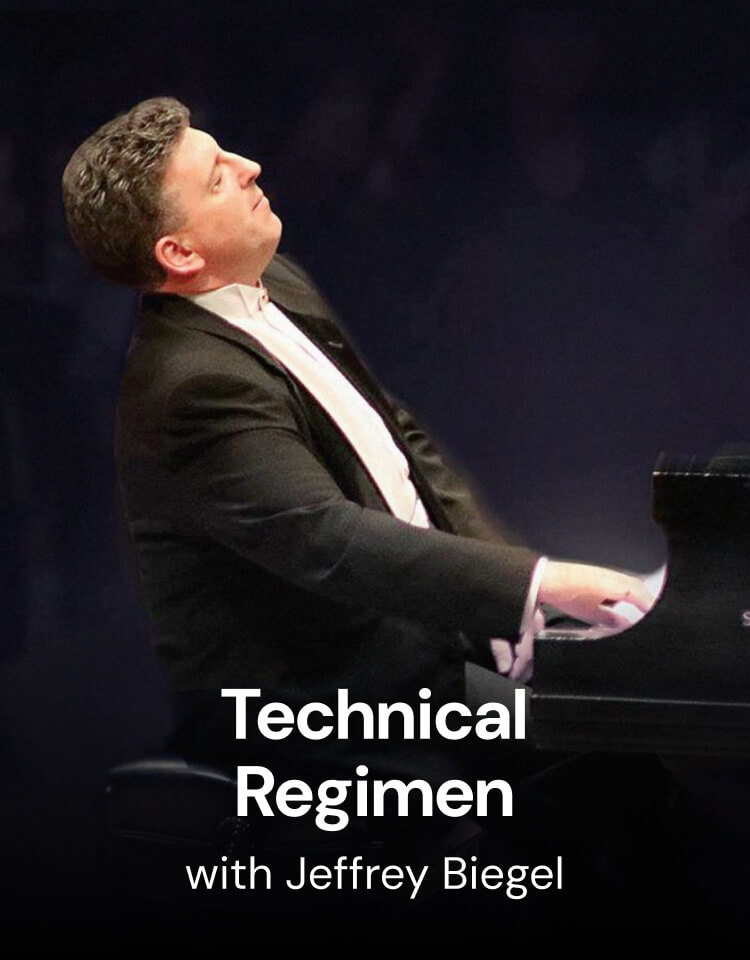
Jeffrey Biegel

In this lesson, American pianist Jeffrey Biegel shares with you his strategies for practicing Chopin’s Étude No. 6 in G-sharp Minor, Op. 25. <br><br>While fingerings vary according to the edition that you choose to use, you will likely be forced to use your weakest fingers (your pinky and ring fingers) to play the top notes of the double-third figures that dominate this piece. To make the top notes sing, Biegel advises you to practice playing them legato while playing the bottom notes staccato. He also explains the “add-a-note” practice technique, which he encourages you to use to reinforce your double-third runs. While you’ll want your runs to sound even and seamless, they should still sound musical. To give your runs a sense of shape and direction, you can sing along with them – Biegel imagines that your vocalizations will inform your playing. <br><br>Finally, you will learn to tackle the runs of broken seventh chords that appear throughout this piece. Biegel invites you to practice playing these runs beyond their notated ending point. When you go back to playing the runs as they’re written, they won’t seem so daunting anymore!

  • checkmark icon
    Difficulty: 
    Advanced
  • checkmark icon
    Duration: 
    1
     hours
     hour
All courses on tonebase include subtitles in English and Spanish

Course Syllabus

Etude Op. 25 No. 6 in G-sharp Minor

In this lesson, American pianist Jeffrey Biegel shares with you his strategies for practicing Chopin’s Étude No. 6 in G-sharp Minor, Op. 25.

While fingerings vary according to the edition that you choose to use, you will likely be forced to use your weakest fingers (your pinky and ring fingers) to play the top notes of the double-third figures that dominate this piece. To make the top notes sing, Biegel advises you to practice playing them legato while playing the bottom notes staccato. He also explains the “add-a-note” practice technique, which he encourages you to use to reinforce your double-third runs. While you’ll want your runs to sound even and seamless, they should still sound musical. To give your runs a sense of shape and direction, you can sing along with them – Biegel imagines that your vocalizations will inform your playing.

Finally, you will learn to tackle the runs of broken seventh chords that appear throughout this piece. Biegel invites you to practice playing these runs beyond their notated ending point. When you go back to playing the runs as they’re written, they won’t seem so daunting anymore!

Click here to download the course workbook PDF and see the full syllabus →
Access this course and hundreds more.

Click below to access hundreds of exclusive piano courses, available only on tonebase.

Unlock Course →
Jeffrey Biegel
meet YOUR INSTRUCTOR

Jeffrey Biegel

An heir to the legacy of Josef Lhevinne and Adele Marcus, Jeffrey Biegel has garnered a reputation as a prolific pianist and sought-after teacher.

read full bio →
Jeffrey Biegel

Learn from legendary pianists

Explore 1,000+ in-depth lessons taught by GRAMMY winners, Juilliard professors, and world-renowned performers, covering everything from timeless repertoire to advanced technique and artistry.

Listen to a few tonebase stories. Ready to start yours?