


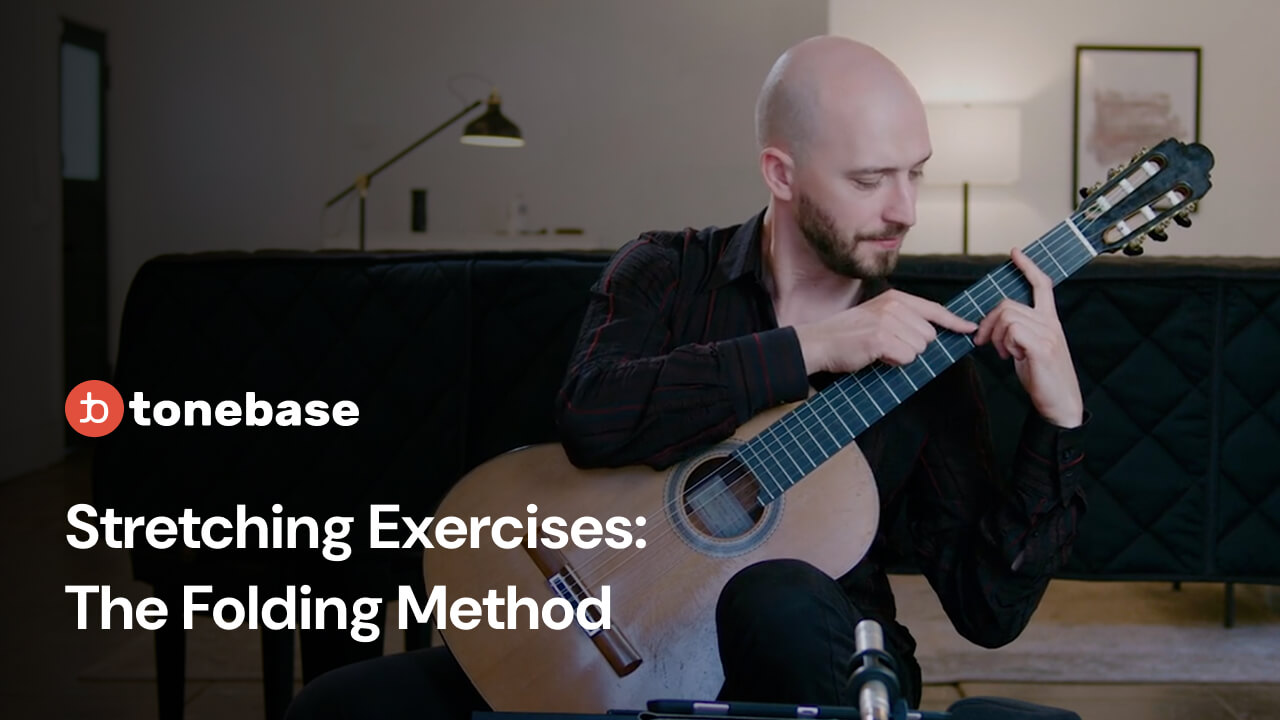
Table of Contents
- Why "spread your fingers wider" is the wrong advice
- The folding method explained
- Wrist rotation: the enabler
- The core-and-satellite principle
- The four elements of a safe stretch
- Applying the method to repertoire
- A daily practice protocol
- When to stop
- Frequently asked questions
Introduction
Ask most classical guitarists how to approach a hard stretch — a Villa-Lobos etude passage, a big Brouwer chord, the notorious reach in Granados's Ocho Valses Poéticos — and they'll describe the same picture. Spread the fingers wider. Push through the discomfort. Hope the hand eventually adapts.
That approach is wrong, it doesn't work, and it causes real injuries.
Mircea Gogoncea reports in his tonebase lesson On Stretching: LH Technique that stretching is "the most requested technical topic on the tonebase forums." The answer he gives is not what players expect — and once you absorb it, the hardest stretches in the classical guitar repertoire become significantly easier, safer, and more musical.
This article is the complete version of what Gogoncea teaches, supplemented by shared principles from Bill Kanengiser, Gaëlle Solal, and Łukasz Kuropaczewski.
1. Why "spread your fingers wider" is the wrong advice
Quick answer: The human hand isn't built for maximum lateral spread between adjacent fingers. The ligaments connecting the fingers at the base of the palm have limited elasticity, and pushing past that limit causes the injuries common among classical guitarists — strained tendons, inflamed ligaments, and permanent loss of playing ability. Even maximally spread, the distance you gain isn't enough for the hardest classical guitar stretches anyway.
The standard intuition about stretching is that you spread the fingers of your left hand as wide as possible, keeping them parallel to the fretboard, and force them to reach the required distance through brute flexibility.
Gogoncea demonstrates why this fails — and why it hurts.
💬 "If I try to achieve the absolute maximum distance between these two fingers, this is about as far as I can go. This hurts. This is too much for my fingers right now." — Mircea Gogoncea
The reason is anatomical. The human hand is not built for maximum lateral spread between adjacent fingers. The interdigital ligaments connecting the fingers at the base of the palm have limited elasticity, and the muscles that abduct (spread) the fingers are small and quickly fatigued. A guitarist who has played for years might develop more range in these muscles than a non-player, but only marginally. There is a ceiling, and pushing against that ceiling is how people injure themselves.
The deeper problem: even if you could spread your fingers wider, you wouldn't get much more distance from it. The extra distance between your thumb and pinky when you maximally spread your hand is only a few centimeters. On a guitar neck, a few centimeters is often not enough for the stretch the music actually demands.
There's a better way, and it's almost embarrassingly simple once you see it.
2. The folding method explained
Quick answer: The folding method produces a larger stretch between two fingers by folding the other fingers into the palm, rather than spreading all four fingers flat. This works because folding uses the hand's natural architecture (closing into a fist) instead of fighting it (forcing fingers apart). The distance gained is significantly greater than parallel spread — often an extra half inch or more.
Gogoncea's core insight: the distance between two fingers is much larger when the other fingers are folded away than when all four fingers are spread flat.
Try this now, away from the guitar
- Hold your left hand out flat and spread your fingers as wide as they'll go.
- Measure the distance between the tip of finger 1 and the tip of finger 4 with your eyes. That's your maximum "parallel" stretch.
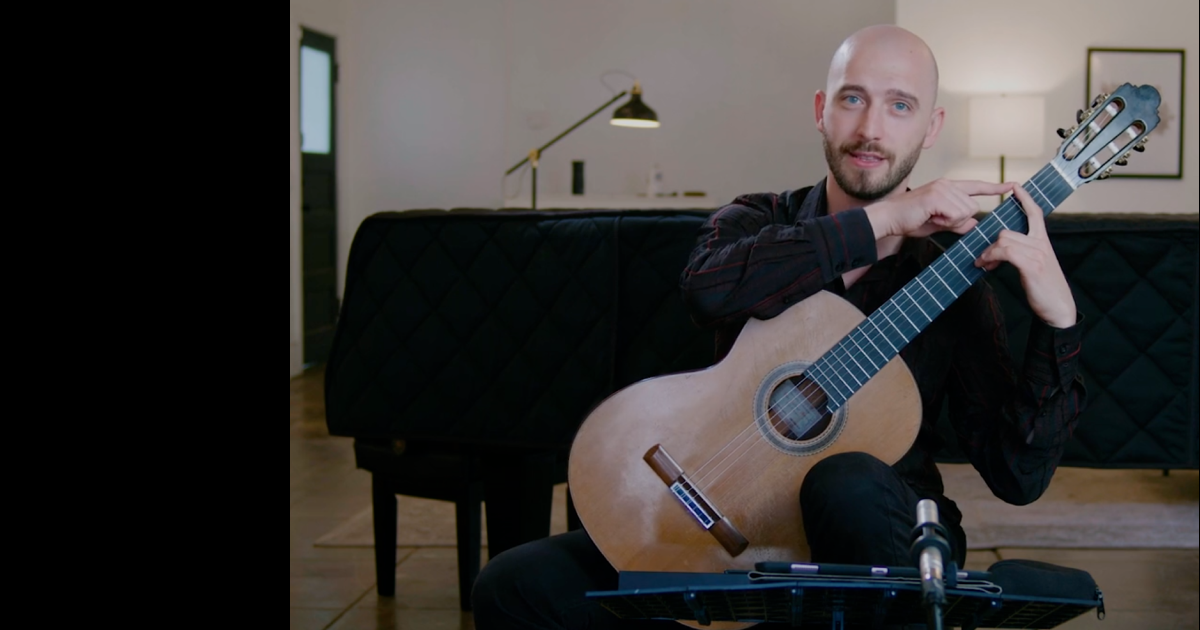
- Now fold fingers 2 and 3 into your palm, and spread fingers 1 and 4 outward.
- Measure again. The distance is dramatically larger — significantly more than the parallel version.
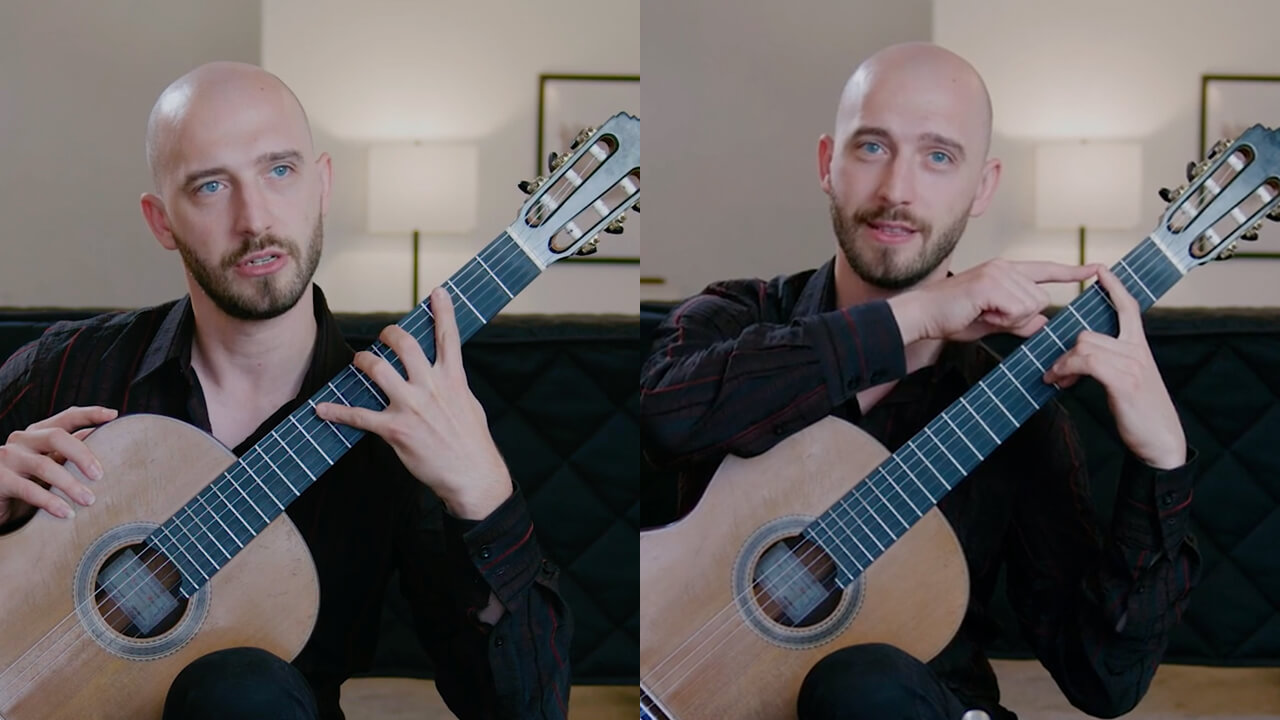
💬 "By folding fingers down and letting others be stretched out, we can accomplish a much, much larger stretch than by attempting to do this." — Mircea Gogoncea
Why the folding method works
Physical reason: when fingers 2 and 3 fold into the palm, the joint mechanics of the hand open up differently. The pivot points shift. The muscles that would normally be stretched in the parallel position are now slack or passive. The work of creating distance is done by folding the inactive fingers rather than forcing the active ones apart.
Why this is safer
The folding motion is a motion the hand is designed for — closing the fingers into the palm is what hands do naturally. The parallel-spread motion is one the hand is not designed for. Stretching with the folding method uses the hand's natural architecture. Stretching against it fights the architecture and produces injury.
Why this is more powerful
The distance achievable via folding is larger than what's achievable via parallel spread — often by half an inch or more on a full hand. On a guitar, half an inch can be the difference between a stretch that works and one that doesn't.
Why it's more musical
A hand stretched via folding has more remaining capacity for expressive nuance. A hand stretched via parallel spread has used all its available flexibility on the stretch itself, leaving no room for dynamic control, vibrato, or follow-up movement. The folding method leaves the hand in a state where it can still play music — not just survive the stretch.
3. Wrist rotation: the enabler
Quick answer: The folding method depends on rotating the wrist so the fingers approach the strings at an angle — not parallel to the fretboard. This contradicts standard beginner pedagogy that tells players to keep the palm parallel at all times. For advanced stretches, rotating the wrist (bringing the elbow outward) is what makes the folding method physically possible.
The folding method depends on being able to rotate the wrist so that the fingers approach the strings at different angles. This is where Gogoncea's teaching contradicts standard guitar pedagogy directly.
💬 "The number one misconception that makes us unable to stretch properly is that our left hand is always supposed to be parallel to the fretboard." — Mircea Gogoncea
Many beginner methods teach that the palm of the left hand should be parallel to the fretboard at all times. The fingers drop straight down onto their frets. The hand stays square to the neck. This is reasonable advice for a beginner developing basic hand position, but applied universally it prevents most advanced stretches.
The alternative
Rotate the wrist to let the hand approach the stretch from an angle. Specifically, when you need a large stretch, bring your elbow outward and rotate your palm as if you were turning a knob. The hand comes off its parallel orientation, the fingers approach the strings at a diagonal, and the folding method becomes available.
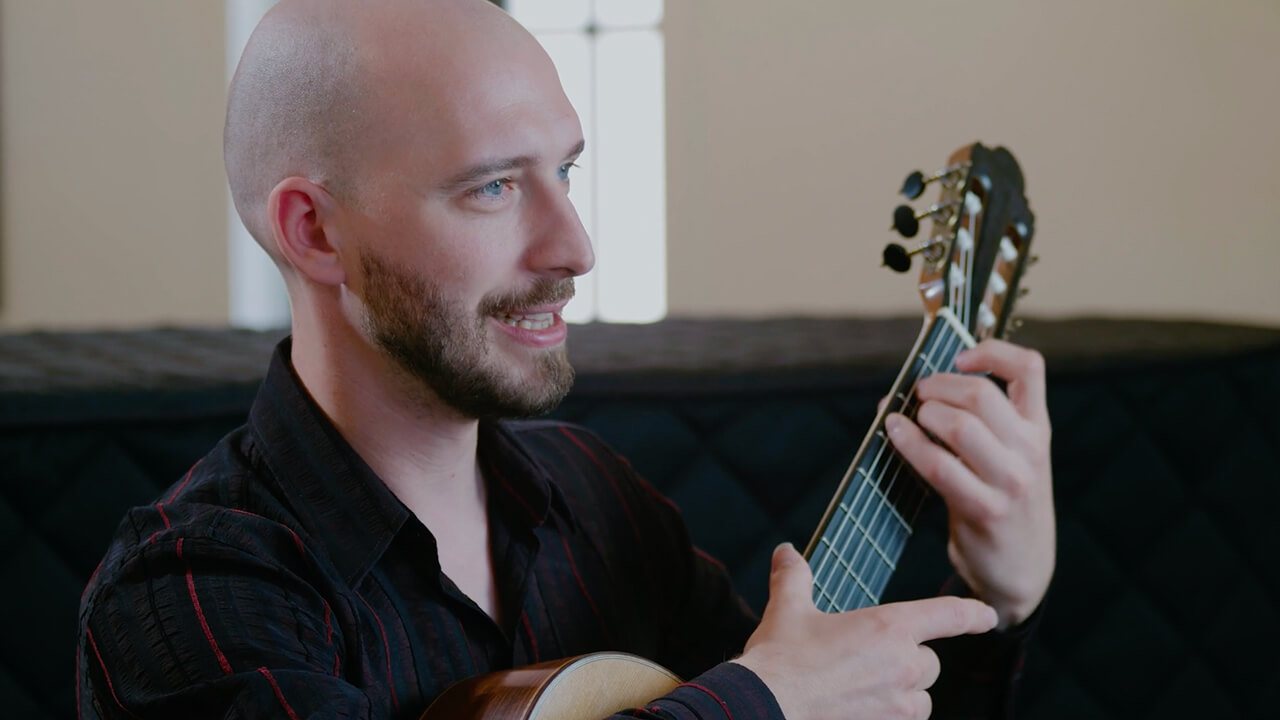
Three angles of approach
Gogoncea names two rotated positions plus the standard:
- "Coming from the left" — the finger approaches the string from its left side. The joint of the finger is to the left of the fingertip.
- "Straight-on" — the standard parallel position.
- "Coming from the right" — the finger approaches from its right side. The joint is to the right of the fingertip.
Different stretches benefit from different angles. An extension to the lower (thinner) strings typically benefits from coming from the left. An extension to the higher (thicker) strings benefits from coming from the right.
The practical test: for any stretch you're struggling with, try each of the three approach angles — straight-on, from the left, from the right — and notice which one is most comfortable. The answer is often surprising. A stretch that is painful straight-on is easy from the right.
4. The core-and-satellite principle
Quick answer: When executing a large stretch, place the "core" of the hand first (the fingers carrying the bulk of the position) and then extend the "satellite" finger to its target — not the reverse. Placing the stretched finger first forces the rest of the hand to contort around it. Placing the core first lets the satellite extend naturally.
Most players approach a hard stretch by placing the first finger in position, then trying to extend to the target with another finger. This is backwards.
💬 "It's always easier to start with the core of the hand being in position and then moving one finger away to where it needs to be, rather than the opposite. It's kind of like thinking of this finger as a satellite. The solar system is here. The satellite is way over to the side." — Mircea Gogoncea
The right order
- Place the core of the hand (fingers 2, 3, or 4 — whichever will hold the bulk of the position) in its target position first.
- Then extend the satellite finger (usually finger 1) outward to its stretched position.
This works because the core fingers define the hand's spatial orientation. Once they're placed, the hand "knows" where it is, and the satellite finger can extend naturally. Placing finger 1 first asks the whole rest of the hand to follow into position, which is the harder movement.
A real example: Granados, Ocho Valses Poéticos
Gogoncea demonstrates this with a passage from the end of Valse No. 6 in Granados's Ocho Valses Poéticos — in the Joaquín Clerch transcription, one of the hardest stretches in the repertoire:
- Finger 1 plays F-sharp on the 6th string at the 2nd fret.
- Finger 2 plays A on the 1st string at the 5th fret.
- Finger 1 then has to reach to the ornament note on B, 5 frets away from finger 2.
This is a massive cross-string stretch. The wrong way: place finger 1 first, then try to get the rest of the hand into position. The right way: place finger 2 first, settle the hand in 5th position, then extend finger 1 outward to its target.
💬 "I'm not going first finger first and then to the right. That is more difficult. Start with the core and then extend the finger. That will allow you to make this movement work." — Mircea Gogoncea
This principle applies to every large stretch in the repertoire. If a passage feels impossible, re-examine your order of finger placement. The easy order is almost always: core first, satellite last.
5. The four elements of a safe stretch
Quick answer: Every successful classical guitar stretch has four elements: (1) folding non-active fingers into the palm, (2) rotating the wrist to the appropriate angle, (3) placing the core of the hand first and extending the satellite finger second, and (4) using minimum pressure on the stretched finger. Missing any element turns a safe stretch into a strain.
Combining everything above, every successful stretch on classical guitar has four elements:
Element 1: Use the folding method
Non-active fingers fold into the palm rather than staying parallel. Active fingers extend in the direction of the stretch.
Element 2: Rotate the wrist
The hand comes off its parallel orientation to approach the stretch from the appropriate angle — left, right, or straight-on.
Element 3: Core-and-satellite order
Place the core of the hand first, then extend the satellite finger. Not the reverse.
Element 4: Minimum pressure
The stretched finger presses only as hard as needed to produce a clean note — not harder to compensate for the stretch. Bill Kanengiser's thunk-buzz-note principle applied under extension.
When all four elements are present, a stretch that seemed impossible becomes merely difficult, and eventually routine. When any one is missing, the stretch is a daily struggle — and a potential injury.
{{trip-wire}}
6. Applying the method to repertoire
Quick answer: The folding method applies to virtually every stretch in the classical guitar repertoire — from Granados's Valses Poéticos to Villa-Lobos's Etudes and modern works by Brouwer and Castelnuovo-Tedesco. Different stretch types (cross-string, wide-chord, contrary-motion) benefit from different emphases, but the four-element framework always applies.
Gogoncea's lesson works through seven specific passages. Here's how to apply the folding method to the common stretch types in the repertoire.
Type 1: Large cross-string stretches
Examples: Granados Valse No. 6, Villa-Lobos etudes, Brouwer Elogio de la Danza.
Cross-string stretches almost always benefit from wrist rotation plus core-and-satellite order. Place the string you'll be on longest first; extend the satellite finger second.
Type 2: Wide chord voicings
Examples: Moreno-Torroba Sonatina, Castelnuovo-Tedesco chords.
Many modern guitar chords contain notes spanning 4–5 frets within a single chord. These require the folding method: the middle fingers fold out of the way of the outer fingers' reach. Wrist rotation is less important here because the stretch is within a single position; the key is that fingers 2 and 3 fold toward the palm.
Type 3: Contrary-motion passages
Examples: Villa-Lobos Etude No. 1.
Passages where the outer voices move apart simultaneously can feel unplayable with parallel-spread intuition. The solution is that each finger individually approaches from its correct angle — the low fingers from the left, the high fingers from the right — while the hand rotates to accommodate both.
Type 4: Extended slur patterns
Examples: Villa-Lobos Etude No. 3, Sor studies.
When slurs happen over wide fret distances, the difficulty isn't the slur itself — it's the hand position supporting it. The folding method lets the hand sustain the stretched position without the fretting finger losing contact strength.
Type 5: Bach polyphony
Examples: Bach Lute Suites (BWV 995, 996, 997, 998), Cello Suites on guitar.
Bach's guitar transcriptions often require simultaneous holding of voices across the fretboard. The folding method lets middle fingers fold while outer fingers hold their notes. Bill Kanengiser's seesaw principle — using the right forearm for counter-pressure against the guitar body — pairs well here.
Type 6: Spanish ornaments
Examples: Tárrega works, Albéniz transcriptions.
Fast ornaments with wide leaps benefit from the core-and-satellite order: core in the main position, satellite jumping to the ornament note and back.
Type 7: Contemporary classical
Examples: Brouwer, Britten Nocturnal.
Contemporary repertoire includes stretches unthinkable in earlier periods. These are the passages where the folding method is not optional — they cannot be played at all via parallel spread.
7. A daily practice protocol for building stretch capacity
Quick answer: Build safe stretch capacity across four phases: (1) off-guitar awareness of the folding method, (2) isolated single-stretch drills at slow tempo, (3) integration into real repertoire, and (4) lockdown via Kuropaczewski's 5-repetition protocol. Expect weeks of daily practice before a difficult passage feels reliable.
Building genuine stretch capacity takes weeks to months, and requires consistent, injury-aware practice. Here's a protocol that integrates Gogoncea's folding method with related principles from Kanengiser and Kuropaczewski.
Phase 1 (Week 1–2): Off-guitar awareness
Spend five minutes daily practicing the folding method away from the instrument. Hold your left hand out, try parallel spreads, try folding + extending. Rotate your wrist to different angles. Notice which combinations produce the largest distances without pain. Build the motor pattern of folding before applying it to the guitar.
Phase 2 (Week 2–4): Single-stretch drills
Choose three stretches from repertoire you're working on — easy, medium, hard. Practice each one daily using the four elements:
- Folding fingers into the palm for non-active ones
- Wrist rotation to the appropriate angle
- Core-and-satellite order
- Minimum pressure (Kanengiser's threshold test)
Five slow repetitions each, at 60 BPM or slower. Stop immediately if anything hurts.
Phase 3 (Week 4+): Integration into pieces
Apply the method to real repertoire passages. Identify every hard stretch in a piece you're learning. For each one, re-examine:
- Am I using the folding method or spreading flat?
- Am I approaching from the correct angle?
- Am I placing the core first or the satellite first?
- Am I pressing harder than necessary?
Fix whichever of the four is wrong. Record yourself. Listen for evenness — a well-executed stretch should sound identical in volume and tone to the notes around it.
Phase 4 (ongoing): Kuropaczewski's 5-rep protocol
Once a stretched passage is working, lock it in with five clean repetitions daily at 60 BPM using the full preparation sequence — right hand plants, left hand places, left hand presses, right hand plucks. Buzz and hesitation become structurally impossible.
8. When to stop
Quick answer: Pain is information. Discomfort from a new stretch is normal; actual pain is not. Stop immediately if you feel sharp, sudden, or persistent pain. Take a day off. If pain persists, consult a hand therapist or physician who works with musicians — untreated stretching injuries can end careers.
Pain is information. If a stretch hurts at any point in this process — not just discomfort, but genuine pain — stop immediately. The folding method is designed to avoid pain; if you're in pain while using it, something is wrong with your execution. Either the wrist rotation isn't enough, the core-and-satellite order is reversed, or you're pressing too hard on the extended finger.
Take a day off. Try again slowly. If pain persists, see a hand therapist or doctor who works with musicians. Injury from aggressive stretching can end careers; it is not worth pushing through.
On the other hand: normal flexibility training takes time. You will not unlock a hard stretch in a single session. The folding method makes a previously-impossible stretch possible, but not instantly effortless. Expect weeks of daily practice before a difficult passage feels reliable.
Gogoncea closes his lesson with a sentence worth remembering:
💬 "There is a way for us to play complicated stuff using our left hand — without having it hurt and without putting a lot of strain on it. There are many ways of achieving distance between the fingers." — Mircea Gogoncea
The way that doesn't hurt is the folding method. The way that does is the parallel spread. Choose the first one.
Frequently asked questions
How do I stretch my fingers for classical guitar?
The safest way is the "folding method" taught by Mircea Gogoncea: fold your non-active fingers into your palm while extending your active fingers outward, and rotate your wrist so the hand approaches the stretch at an angle rather than parallel to the fretboard. This produces more distance than spreading your fingers flat, uses the hand's natural architecture, and dramatically reduces injury risk.
Why do my fingers hurt when I stretch on guitar?
Pain almost always comes from using parallel finger-spread — forcing fingers 1 through 4 apart while keeping them flat. The hand isn't designed for this motion, and the ligaments at the base of the fingers have limited elasticity. Switching to the folding method (folding non-active fingers into the palm) eliminates most stretching pain. If pain persists even with the folding method, stop stretching and consult a hand therapist.
Can I permanently damage my hand by stretching too hard?
Yes. Aggressive stretching can cause tendonitis, ligament strains, focal dystonia, and in severe cases permanent loss of fine motor control. Classical guitarists have ended careers from stretching-related injuries. The single best preventive measure is to use the folding method instead of parallel spread, and to stop immediately when any stretch causes pain (not discomfort — pain).
How long does it take to build hand flexibility for classical guitar?
Building genuine stretch capacity takes weeks to months of consistent daily practice. A previously-impossible stretch typically becomes reliable in 3–6 weeks of 5-minute daily sessions using the folding method. Faster progress is possible but carries higher injury risk. Slower progress is safer but requires patience. There is no way to skip the time investment safely.
Should I stretch my hands before playing classical guitar?
Light stretching before playing is helpful — particularly for the forearms and wrists. Aggressive finger-spread stretching as a "warm-up" is not helpful and can be harmful. Most concert guitarists use a short chromatic scale or a passage from a warmup piece instead of formal stretching. Eliot Fisk's chromatic octave run is a good example.
What's the widest classical guitar stretch I can practice?
There's no single answer — it depends on your hand size, playing experience, and the piece. The Granados Valse No. 6 example from Gogoncea's lesson (F#–A–B across strings and frets) is near the upper limit of standard repertoire. Contemporary works by Brouwer and Britten sometimes demand larger stretches. The key isn't to stretch as wide as possible; it's to play the specific stretches your repertoire requires, using the folding method to do so safely.
Can I play classical guitar with small hands?
Yes. Stephanie Jones, Gaëlle Solal, and many other professional concert guitarists have smaller-than-average hands. The folding method is especially valuable for players with small hands because it multiplies the effective reach without requiring anatomically impossible spreads. Short-scale guitars (650mm or less) are also a reasonable option — many professional guitarists play shorter-scale instruments specifically for comfort.
What's the difference between finger stretching and hand flexibility exercises?
"Finger stretching" usually refers to passive stretches that hold a position for time — which can be dangerous if done aggressively. "Hand flexibility exercises" usually refers to active, functional movements that build range within actual playing technique. The folding method is a flexibility exercise rather than a stretching exercise: you build the ability to reach distances through positioning and technique, not through passively forcing ligaments to lengthen.
Next steps
Back to the hub: Classical Guitar Technique: The Complete Guide
Related deep-dive guides:
- Classical Guitar Left-Hand Technique
- Classical Guitar Right Hand Technique
- Classical Guitar Slurs: Hammer-Ons and Pull-Offs
- How to Play Barre/Bar Chords on Classical Guitar
Learn left-hand technique from the tonebase faculty
Mircea Gogoncea's On Stretching: LH Technique is one of 700+ courses on tonebase. Get unlimited access to every lesson referenced in this guide.
Start your free tonebase trial →
Sources
- Mircea Gogoncea — On Stretching: LH Technique
- Bill Kanengiser — On Left Hand Efficiency
- Gaëlle Solal — Carlevaro Left-Hand Technique: Key Concepts
- Łukasz Kuropaczewski — Practice Principles, Guitar Technique Booster


