


Table of Contents
- What classical guitar technique actually means
- Right-hand technique
- Left-hand technique
- Slurs, barres, and harmonics
- Tone, phrasing, and musicality
- Speed, flexibility, and warming up
- Practice principles that tie it together
- Frequently asked questions
- Next steps: courses and deep-dive guides
Introduction
Ask ten classical guitarists what "technique" means and you'll get ten different answers. Some will describe it as finger strength and agility. Others will call it the polish of years of scales and arpeggios. A few — the ones whose playing actually tells you something — will talk about economy of motion, attention, and the relationship between how you move and what the music sounds like.
That last group is right. Technique is not the opposite of musicality. It is musicality — enacted in the body. Every expressive choice a guitarist makes, from the softest pianissimo to the sharpest rhythmic attack, has a physical cause. The physical cause either serves the musical intent cleanly, or it fights it. Good technique is the state in which the body stops fighting.
This guide is a tour of how working concert artists and teachers on tonebase actually think about the problem. It doesn't replace a teacher, a course, or the thousands of hours of slow practice that no article can shortcut. What it does is show you the map — the conceptual landscape that classical guitar technique occupies — and point you toward deep-dive articles for each region.
Fourteen teachers inform what follows: Marco Tamayo, Łukasz Kuropaczewski, Aniello Desiderio, Bill Kanengiser, Matt Palmer, Ali Arango, Gaëlle Solal, Thomas Viloteau, Mircea Gogoncea, Stephanie Jones, Borbála Seres, Eliot Fisk, Joaquín Clerch, and Jan Depreter. All of them active concert artists. All of them currently teaching on tonebase Guitar.
💡 Start practicing with the world's best guitarists — start your free 14-day tonebase trial and access every lesson referenced in this guide.
{{trip-wire}}
1. What classical guitar technique actually means
Quick answer: Classical guitar technique is a finite system of physical movements — eight right-hand strokes and five left-hand movements, according to Marco Tamayo — combined by a small set of rules. Mastering it means internalizing these components so deeply that musical intent can flow through them without friction.
Marco Tamayo opens his Essential Principles lesson with a claim that sounds absurd until you take it seriously: there are only eight basic movements in classical guitar technique, and they combine according to about twenty-eight rules. Eight movements, twenty-eight rules. "Not everyone can write the poem and be Hemingway," he says — but the alphabet is finite. The grammar of guitar technique is finite too. What distinguishes great players from good ones is not secret knowledge, but the depth at which they have internalized this small, learnable system.
Tamayo's framing makes technique unmysterious. There is a closed set of right-hand strokes, a closed set of left-hand movements, a closed set of principles for combining them in time. Learn the pieces, learn the grammar, and the rest is practice.
The Polish guitarist Łukasz Kuropaczewski arrives at the same ground from a different angle. In his Practice Principles lesson, he states a principle so geometric it borders on obvious once you hear it: the smaller and slower the movement, the more precise. A finger hovering one millimeter above a string can land with precision because the target is immediately beneath it. A finger lifted three centimeters must travel a longer arc, arrive from a steeper angle, and compress the timing of the approach into the last fraction of the motion. More distance means more tension, more inaccuracy, more noise.
💬 "Playing guitar is about the smallest and slowest movements possible. Smaller motion = more precise. Close to the string = almost no chance of missing." — Łukasz Kuropaczewski
Put Tamayo and Kuropaczewski together and you have a working definition: technique is the set of minimal, efficient movements that let you produce the music you hear in your head. It is never about doing more. It is always about doing exactly what is needed, and no more than that.
This reframe has a practical consequence. Students who think technique is about building strength and speed tend to practice by adding — more reps, more pressure, more tension. Students who think of it Tamayo's and Kuropaczewski's way practice by subtracting: less motion, less pressure, less effort. The second group goes faster over time. The first group plateaus and gets injured.
2. Right-hand technique
Quick answer: The classical guitar right hand is your voice — it produces every note and controls tone, volume, and color. Core elements include nail shape (roughly 40% of tone), the stroke motion (the other 60%), the AMI scale system, and the dial between contact surface and finger speed that determines dynamics.
Aniello Desiderio's On Sound Production — his very first lesson on tonebase — opens not with a drill but with a memory from theory class at age seventeen. His textbook defined music in two lines: the art of sound. He has never stopped thinking about what that phrase demands. The guitar is your voice. The finest musical idea, spoken in a thin, strangled, or mechanical voice, loses most of its power. Sound production is the training of that voice.
Everything the right hand does serves this one end. That's worth saying explicitly because it reorders how you think about practice. Scales and arpeggios are not ends in themselves. They are the way you build the daily discipline of producing a beautiful, varied, controlled sound on every note.
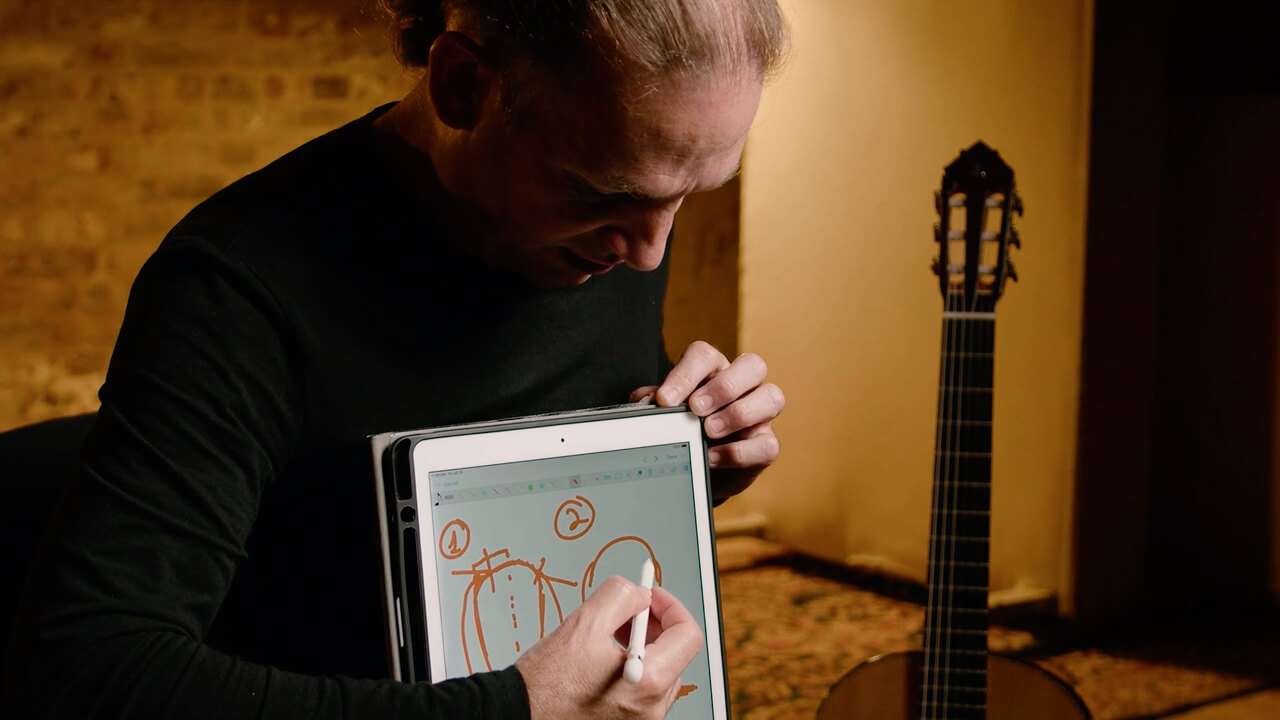
Nails are the interface. Tamayo's 40/60 rule is useful: tone is roughly 40% nail shape and quality, 60% movement and contact. The half-moon nail shape Desiderio teaches — filed into a gentle ramp, polished to a mirror — lets the string ride up the nail smoothly, producing a single smooth contact point rather than the two-point catch that creates metallic noise. File, refine, polish. Then stop fussing with your nails and practice.
The AMI system reframes speed. Matt Palmer's Flawless A-M-I Scales teaches a three-finger right-hand approach, always moving toward the thumb, paired with a three-note-per-string left-hand scale. The genius is that it reduces scales to one coordinated gesture — the right hand closing into a fist produces three notes, the left hand throwing weight from index-side to pinky-side produces three notes, and the two gestures lock together.
💬 "Light is fast." — Matt Palmer
Three words that summarize almost everything about right-hand development. Pressure is the enemy of speed. Keeping fingers barely contacting strings between strokes, using a rolling arm motion rather than static hand jumps, using what Palmer calls a "power stroke" (between free and rest stroke, pushing the string toward the soundhole) — all of it minimizes wasted motion.
Kuropaczewski's caging principle makes Palmer's point physical. In his Guitar Technique Booster, Method 4 places the right-hand a finger on the string adjacent to where i and m are playing, acting as a physical constraint that prevents them from lifting away. Method 5 adds the thumb below, caging i and m between two planted fingers. "The first and second fingers feel like it's inside the cage," he says. The discomfort is the point. Fingers trained inside a constraint learn smaller, more controlled movements. Remove the cage in performance and the motion stays minimal — not because of a rule being applied, but because minimal motion has become the default.
Joaquín Clerch teaches dynamics from inside the stroke. In The Cuban Guitar School, he describes sound production as two variables: surface (how much nail contacts the string) and speed (how fast the finger moves through it). More speed = more volume. More surface = brighter, more resistant tone. Less of either dims the sound. The brilliance is that every stroke has these two dials at all times, continuously adjustable. A fortissimo chord and a pianissimo melody use the same fingers, the same knuckle mechanics, the same follow-through — but with different settings on the surface-and-speed dials.
➡️ Go deeper: Classical Guitar Right Hand Technique: A Complete Guide — the full deep dive on nail shape, AMI, caging, surface & speed, and the exercises that build them.
3. Left-hand technique
Quick answer: The classical guitar left hand should press with minimum pressure — far less than most students use. Bill Kanengiser's research shows the actual pressure required to fret a clean note is only a fraction of the force guitarists habitually apply. Efficient left-hand technique also means fingers close to strings, fixation (mobilizing stronger joints to move weaker ones), and wrist rotation for reaching difficult stretches.
Bill Kanengiser's On Left Hand Efficiency opens with a question he frames as fundamental to the entire experience of playing guitar: why is it so hard? Why does the left hand feel like it must clamp and squeeze constantly to produce a clean note?
His answer, developed over thirty minutes with a homemade monochord, reverses the usual student intuition. Guitarists press too hard because they fear the buzz. They press so hard they can't vibrato, can't sustain long pieces without fatigue, and can't move smoothly between notes. The actual pressure required to fret a clean note is far less than most players use.
His thunk-buzz-note exercise: start with a finger resting lightly on a string; the plucked sound is a dead thud (the "thunk"). Add a little pressure; the string buzzes. Add a little more; the note clears. Add a little more; it clears solidly. Most players never discover how little pressure is actually needed. To find the threshold, reverse the process: start with a fully clean note, then gradually release pressure while repeating it, until the buzz first appears. Note how little pressure remains.
Kanengiser's second insight uses the monochord to explain why less pressure works. When the right hand plucks, it sends a shockwave down the string. The shockwave is what threatens to lift the string off the fret. But the shockwave only occurs at the beginning of the note. After the first few cycles, the string has settled and needs much less pressure to stay pinned.
💬 "The moment in any given note that we have to press really firmly is always at the beginning of the note, when the shockwave comes in. After that, we can relax the pressure a little bit." — Bill Kanengiser
This insight changes how legato feels. A finger that presses hard at the attack, then relaxes, can vibrato freely and move to the next note without a sudden unclamp. A finger that grips continuously can do neither.
Gaëlle Solal teaches the Carlevaro method, and in her Key Concepts lesson she introduces the single most important frame for left-hand organization: fixation. Carlevaro's word for the deliberate immobilization of one articulation in order to mobilize a stronger one. Fingers are weak. The hand is stronger. The wrist is stronger still. The arm and shoulder are strongest. By fixing the smaller joints, you recruit the larger ones. A shift doesn't come from finger travel — it comes from arm swing, with the fingers merely along for the ride.
Solal also carries Carlevaro's three-part taxonomy of left-hand movement: substitution (two fingers occupy the same position in succession; a note or fret is the common element), displacement (the hand shifts with the shape preserved; the common element is the hand shape itself), and jump (nothing carries over).
Mircea Gogoncea's On Stretching: LH Technique tackles the most common left-hand misconception head-on: that stretching means spreading the fingers wider. Gogoncea demonstrates that the hand is simply not built to spread maximally — the distance between fingers 1 and 4 when spread flat is actually less\ than the distance you can achieve by folding the non-active fingers and rotating the wrist. The folding-and-rotating approach is also safer and less tiring.
💬 "If I try to achieve the absolute maximum distance between these two fingers, this is about as far as I can go. This hurts... There is another way of achieving a lot more distance. Instead of stretching like this, doing this." — Mircea Gogoncea
This is not an edge case. Most hard stretches in the repertoire — Villa-Lobos etudes, Moreno-Torroba Sonatina, big Brouwer chords — become dramatically easier the moment you stop trying to force parallel fingers across the neck and start rotating the wrist to allow the hand to approach the stretch at an angle.
Kuropaczewski's shift mechanics complete the picture. In his Technique Booster, shift exercises emphasize that the highest-numbered active finger becomes the position guide — it keeps all fingers close to their targets, preventing the outer fingers from drifting away from the neck during movement. Combined with the "soft before the shift" rule from his Llobet lessons — play softer just before a difficult shift so the decay hides the LH release — shifts become acoustically invisible rather than audible effort.
➡️ Go deeper:
4. Slurs, barres, and harmonics
Quick answer: Slurs are notes produced by left-hand action alone (hammer-ons and pull-offs). Barres are single-finger chords covering multiple strings. Harmonics are bell-like overtones produced by touching specific fret points. All three are fundamental to classical repertoire and each rewards dedicated study.
Slurs — ascending hammer-ons and descending pull-offs — are the two fundamental ways to play a note without plucking it. Tamayo teaches them as two complementary movements. The descending slur is mechanically simpler: pull the fretting finger slightly toward the adjacent lower string and release rapidly, letting the string's own tension produce the note. The ascending slur is a hammer from above, and here Tamayo's rule is geometric: "the shortest distance between two points is a straight line — be smart and do this." The finger descends in a straight drop from its starting position to the target string. Any curve in that path wastes energy.
The common mistake is to make slurs louder by adding arm weight. They should be produced by the fingers' own small motion plus the string's own tension. Arm involvement makes them heavy without making them stronger.
Barre chords are mostly taught as a strength problem. They are not. Thomas Viloteau's Advanced Barre lesson reframes the whole topic around selective pressure and MCP joint position. Selective pressure: in most real repertoire, you do not need all six strings sounding from the barre. A La Catedral passage might only need strings 1 and 5. If the middle strings buzz slightly, that is acceptable — you are not playing them. Consciously decide which strings require pressure before applying any force.
The MCP — the big knuckle where the finger meets the hand — determines whether the barre is even possible. If the MCP is below the neck, the finger curves the wrong way; a full barre becomes extraordinarily difficult. If the MCP is level with the neck, it's better but still forceful. If the MCP is above the neck, the finger naturally curves toward the fretboard, distributing pressure evenly across all strings with minimal force.
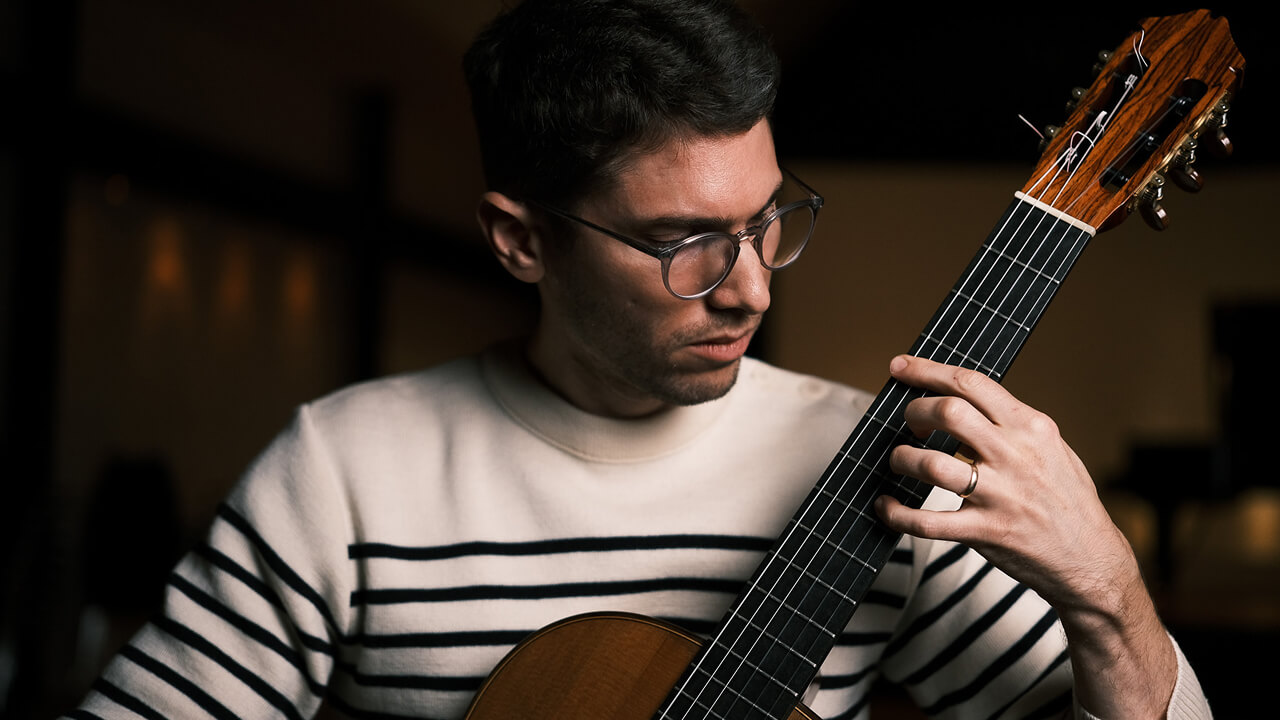
Viloteau's second insight: pressure doesn't have to come from the thumb-clamp. The latissimus dorsi — the back muscle pulling the whole arm toward the body — can supply most of the pressure a barre needs. Optimal distribution: roughly 50% hand clamp, 50% back-pull. This halves the fatigue of long barre passages.
Harmonics come in two kinds. Natural harmonics are produced by lightly touching the string directly over certain frets (12, 7, 5, 4); plucking then lifting the left-hand finger at the moment of the stroke yields a bell-like overtone. Artificial harmonics combine a fretted note with a right-hand finger one octave above to produce the same effect at any pitch.
➡️ Go deeper:
- Classical Guitar Slurs: Hammer-Ons and Pull-Offs
- How to Play Barre/Bar Chords on Classical Guitar
- How to Play Guitar Harmonics
5. Tone, phrasing, and musicality
Quick answer: Classical guitar tone is controlled by the right hand through two variables — the nail's contact surface with the string, and the speed of the finger through it. Phrasing and musicality extend tone control into time: dynamics, tempo, articulation, tone color, accentuation, phrase direction, and breathing are the seven tools Borbála Seres identifies as the full expressive toolkit.
Technique that doesn't serve music is just calisthenics. The four teachers below show how the best players turn mechanical control into expressive communication.
Desiderio's diving board exercise isolates the single most important moment in right-hand production: the instant of string release. The metaphor: a diver at the edge of the board, with weight on the edge, then launching. The finger "dives" into and through the string, not stopping at the surface. Players who stop their finger at the string produce a bright, glassy tone with no depth. Players who let the finger travel through the string produce a full, round sound with body.
He pairs it with the bicycle exercise: the right hand moves in a continuous circular motion, from preparation through stroke through follow-through back to preparation, like pedaling. The goal is a smooth even rotation rather than a series of discrete jerks.
Stephanie Jones's five-step melody plan is one of the clearest frameworks in the tonebase catalog for turning a mechanically-correct melodic performance into an expressive one:
- Isolate the melody with a highlighter on the score. Know exactly which notes are melody and which are accompaniment.
- Play the melody alone without any accompaniment. Strip the line bare.
- Sing the melody. Use your voice to find natural breath points, instinctive dynamic contour, organic articulation.
- Analyze the score. Study contour, high points, harmonic events. Semitones demand tension-and-release. Diminished chords carry heightened emotion.
- Give it personality. Apply vibrato, tone color, rubato, dynamics — informed by singing and analysis.
Jones puts intuition (singing) before analysis, so that calculation refines rather than overrides the body's instincts. "It has to sound like a human voice, not like a guitar."
Borbála Seres extends Jones's frame into a full taxonomy. Her Phrasing and Articulation lesson identifies seven tools of musical expression: tempo, dynamics, tone color, accentuation, articulation, phrasing (tension), and breathing. Two of her points are worth repeating here because they often get lost in the pursuit of technical polish:
💬 "With the music, we always have to be careful not to play everything always in legato. Legato is beautiful for singing, but we have also many different articulations." — Borbála Seres
Articulation variety — the deliberate choice of which notes connect and which separate — is what creates character. A Bach sarabande played entirely legato sounds smeared. A flamenco-derived Spanish piece played entirely legato loses its rhythmic snap.
Seres's second essential point: breathing. The silences between phrases are as expressive as the notes themselves. Rests are not absences — they are shaped events.
➡️ Go deeper: Classical Guitar Tone
6. Speed, flexibility, and warming up
Quick answer: Speed on classical guitar is the outcome of efficient technique, not the goal of it. Fast playing requires phalanx-driven strokes (not fingertip-driven), consistent nail contact, free stroke at the highest tempos, and disciplined practice at slow speeds with Kuropaczewski's 5-repetition protocol at 60 BPM.
Fast playing on classical guitar is not what most students think it is. It is not tension released through effort. It is the outcome of the right-hand and left-hand efficiencies described in the previous sections, applied to tempo. Four teachers deepen this.
Matt Palmer and Ali Arango approach scale speed from complementary angles. Palmer insists on AMI and three-note-per-string as the structural foundation: once the right-hand pattern never varies, speed becomes a matter of refining a single gesture. Arango, in On Fast Scales, adds the biomechanical layer. The phalanx — the proximal joint of each finger — is the primary driver of a fast scale stroke. Fingertip-driven strokes are richer per note but become unreliable at speed.
Arango also addresses nail shape directly: for fast scalar playing, a more pronounced bevel on the attack side (what flamenco players call a picado shape) reduces friction time and allows faster recovery. At the most demanding tempos, Arango exclusively uses free stroke (tirando). Rest stroke's finger-lands-on-adjacent-string mechanism, however musically desirable at slow tempos, adds a fraction of a moment to each stroke; over a long fast passage, that fraction accumulates into audible unevenness.
Eliot Fisk's On Warming Up is three minutes long and contains two ideas worth the entire lesson. First: everything has to be choreographed.\ Guitar fingering is simultaneously orchestration (choosing colors) and choreography (choosing physical movements). Second: Fisk's go-to warm-up is a single chromatic octave run across the entire neck — warming the left-hand shift mechanism, engaging every finger systematically.
Marco Tamayo takes the opposite warm-up position. He does not believe in long warm-ups. His reasoning is concrete: in performance you often walk on stage with cold hands, in wind, heat, or humidity. The ideal condition rarely exists. A long warm-up routine creates a dependency the stage destroys.
Kuropaczewski's 5-rep protocol is the through-line of all serious speed work. Five repetitions per bar, with the metronome at 60, using the full preparation sequence — never five attempts but five executions that meet the standard of the sequence.
➡️ Go deeper:
7. Practice principles that tie it together
Quick answer: The best classical guitar practice uses Łukasz Kuropaczewski's four-step preparation sequence (right hand plants, left hand places, left hand presses, right hand plucks) at 60 BPM with five repetitions per bar. This structural approach makes errors mechanically impossible and builds fearless performance through clean repetition.
Kuropaczewski's four-step preparation sequence appears in his Practice Principles and in every one of his Llobet lessons. The sequence:
- Right hand places all fingers on the target strings. This plants them and stops the strings from vibrating, giving the left hand a stable surface.
- Left hand places fingers on their frets without pressing.
- Left hand applies pressure.
- Right hand plucks, then immediately returns to strings for the next preparation.
The metronome sits at 60. Every repetition follows this order. The result is that buzz becomes structurally impossible — not avoided through attention, but prevented by the sequence itself. A technique that makes errors require deliberate deviation from the procedure is inferior to one that makes errors mechanically impossible.
The psychological payoff is what most players never see:
💬 "My brain doesn't remember mistakes, so I'm also not scared when I perform." — Łukasz Kuropaczewski
If every practice repetition is preparation-mediated, there is no moment in learning when the difficult passage was played incorrectly and stored. The fear that attaches to hard passages never gets encoded. By the time the piece reaches performance, the difficult bars have no emotional history of failure to carry onstage.
Bill Kanengiser's Routine and Performance Anxiety closes the bridge between practice and stage. His most useful offering is Pepe Romero's reframe of backstage symptoms:
💬 "When you're backstage and your knees are shaking, and your hands are sweating, and you can't breathe — that is love. My body is a battery. That's being recharged. Energy I need. Go on stage. And when I go on stage, it flows out to the audience." — Pepe Romero, quoted by Bill Kanengiser
The conventional response to backstage symptoms is to push them away. The player then walks onstage and the suppressed signals flood through. Romero's reframe is the opposite: accept and metabolize the energy during the backstage period, so that stepping onstage is a release rather than a collision.
Frequently asked questions
How long does it take to learn classical guitar technique?
Core technique takes 2–3 years of consistent daily practice to reach an intermediate level where most standard repertoire becomes playable. Building truly professional technique — the kind that lets you perform pieces like La Catedral or the Villa-Lobos etudes without strain — takes 8–12 years. The single biggest accelerator is quality of attention during slow practice, not total hours.
Is classical guitar harder than acoustic guitar?
Classical guitar requires a broader technical vocabulary than steel-string acoustic — fingerstyle right-hand work with individual finger independence, complex left-hand shapes, and note-level control over tone and dynamics. However, classical guitars have wider necks, lower string tension (nylon vs. steel), and don't require the callusing that steel strings demand. Most players find classical more demanding musically but gentler on the hands.
Do classical guitarists use a pick?
No. Classical guitar technique uses the thumb (p) and fingers (i, m, a, and occasionally c) of the right hand directly on the strings. Nails are shaped and polished to produce a consistent tone. A pick removes the ability to play multiple voices simultaneously and to change tone color on individual notes — both central to classical repertoire.
What are the most important classical guitar exercises?
The highest-value daily exercises are (1) Aniello Desiderio's bicycle and diving board for right-hand sound production, (2) Matt Palmer's three-note-per-string scales using the AMI pattern, (3) Bill Kanengiser's thunk-buzz-note exercise for minimum left-hand pressure, and (4) Łukasz Kuropaczewski's preparation-sequence drills at 60 BPM. Combined, these cover both hands and build the foundation for any repertoire.
How much should I practice classical guitar each day?
Quality beats quantity. 60–90 minutes of focused practice produces more progress than 3+ hours of unfocused playing. Bill Kanengiser explicitly recommends stepping away the moment practice starts feeling like struggle: "Every moment that you have the guitar in your hands, it should be a joy." Consistent daily sessions of 45–90 minutes with total attention outperform longer, fragmented sessions.
What's the difference between rest stroke and free stroke?
Rest stroke (apoyando) means the finger plays through the string and comes to rest on the adjacent lower string. Free stroke (tirando) means the finger plays through the string and continues into the air, not contacting the next string. Rest stroke produces a fuller, stronger sound — ideal for melody. Free stroke is lighter and more agile — ideal for accompaniment and arpeggios. Concert artists like Ali Arango actively mix both within a single passage: transitioning from free stroke to rest stroke for a crescendo, or rest to free to taper into an arpeggio. The stroke should follow the musical intent, not be chosen once and applied universally.
Can I learn classical guitar technique without a teacher?
You can reach an intermediate level through high-quality video instruction, structured practice, and disciplined self-observation (recording yourself is essential). Most professional classical guitarists have worked with teachers for the subtleties that video cannot capture — posture adjustments, hand-position feedback, and repertoire interpretation. tonebase's faculty includes Bill Kanengiser, Marco Tamayo, Aniello Desiderio, and others teaching the full technical foundation through structured video courses.
Why does my left hand cramp when I play classical guitar?
Left-hand cramping almost always comes from excessive pressing — applying more force than needed to fret clean notes. Bill Kanengiser's thunk-buzz-note exercise identifies your actual pressure threshold, which is usually far below habitual levels. Cramping can also come from thumb over-squeezing (use the seesaw principle: minimal thumb pressure plus right-arm counter-pressure) or from attempting stretches via parallel finger-spread rather than Mircea Gogoncea's folding method.
Next steps: where to go deeper
The articles below each go deep on a single area of technique. They extend this guide — they don't replace it.
Brand-new deep-dive guides:
- Classical Guitar Right Hand Technique: A Complete Guide — Nail shape, AMI mechanics, the caging principle, surface-and-speed dynamics.
- Classical Guitar Slurs: Hammer-Ons and Pull-Offs — Why slurs sound weaker and how to fix them.
- Classical Guitar Stretching Exercises: The Folding Method — Mircea Gogoncea's wrist-rotation approach.
Other deep-dive guides:
- Classical Guitar Left-Hand Technique
- How to Play Barre/Bar Chords on Classical Guitar
- How to Play Guitar Harmonics
- Classical Guitar Tone
- How to Play Fast on Classical Guitar
- Rasgueado for Classical Guitar Made Practical
- How to Perform Percussive Techniques on Classical Guitar
- How to Practice Classical Guitar
Ready to put this into practice?
Every teacher quoted in this guide teaches full courses on tonebase. Get unlimited access to their lessons — along with 700+ other classical guitar masterclasses from the world's leading teachers — with a free 14-day trial.
Start your free tonebase trial →
About the contributors
This guide draws on lessons from fourteen teachers currently active on tonebase:
- Marco Tamayo — concert soloist, professor at Mozarteum University Salzburg
- Łukasz Kuropaczewski — concert soloist, professor at the Hochschule für Musik Nürnberg
- Aniello Desiderio — concert soloist, founding member of Giuliani Trio
- Bill Kanengiser — founding member of Los Angeles Guitar Quartet, USC faculty
- Matt Palmer — concert soloist, University of Arizona faculty
- Ali Arango — concert soloist, author of Técnica Máxima
- Gaëlle Solal — concert soloist, Carlevaro method specialist
- Thomas Viloteau — concert soloist, GFA First Prize winner
- Mircea Gogoncea — concert soloist, tonebase faculty
- Stephanie Jones — concert soloist, Australian guitarist
- Borbála Seres — concert soloist, Hungarian guitarist
- Eliot Fisk — concert soloist, Mozarteum and New England Conservatory faculty
- Joaquín Clerch — concert soloist, Hochschule für Musik Düsseldorf faculty
- Jan Depreter — concert soloist, Royal Conservatoire Antwerp faculty


