




Table of Contents
- Why there is no one right fingering — and why that's good news
- The crossing problem — what actually goes wrong
- Arango's crossing-avoidance system — a rule for each direction
- Engineering the left hand to fit the right — the Aranjuez scale
- Inestal's criterion — positive and negative string changes
- Kuropaczewski's five methods — and the cage
- Choosing your system — and when to change it
1. Why there is no one right fingering — and why that's good news
Quick answer: A classical guitar scale can be fingered many legitimate ways, because the same pitch is available in several places on the fretboard. Eduardo Inestal frames fingering as independent thinking rather than instruction-following. The variables you are actually designing around are string crossings, position shifts, note grouping, open strings, tone and accent placement.
Most players treat scale fingerings as a lookup table. You find the diagram, you learn the diagram, and if the passage still fights you, you assume the problem is your hands. That assumption is the most expensive mistake in scale practice, because it hides the fact that a fingering is a choice — one of dozens available for the same notes — and choices can be revised.
Eduardo Inestal builds his final scale lesson on this. The guitar, he points out, is unusual in how many legitimate routings it offers for one line of music, and the moment you start choosing between them is the moment you stop being a student of instructions.
💬 "There is not black or white, there is not an absolute truth in what we are doing, but very often many possibilities." — Eduardo Inestal
That is not relativism but a statement about constraints. Any scale fingering is a solution to competing demands, and the demands are concrete enough to list:
- Right-hand geometry. Your fingers are different lengths, and the hand sits at an angle to the strings. Some string changes run with that angle and some run against it.
- Position shifts. Every shift in a fast scale is a hole in the sound unless something covers it.
- Note grouping. How many notes sit on each string decides which right-hand finger arrives on the next string — and whether it has to cross.
- Open strings. They cost you a timbre match and buy you time. Sometimes that trade is worth making.
- Tone. The nail angle that gives a good bass sound is not the one that gives a good treble sound, so where you place an awkward crossing changes the colour of the run.
- Accent placement. A group of four notes played with three alternating fingers puts a natural accent every third note. If the music is in fours, that accent is in the wrong place.
Notice what is missing from that list: talent. These are engineering constraints, and engineering constraints have solutions — which is why a passage that fights you is a solvable problem, not a verdict.
The proof runs through the rest of this article. Ali Arango re-fingered a Villa-Lobos study he had performed for years, swapping a three-finger solution for a two-finger one because the first was putting accents in the wrong place. Inestal re-routes a C major scale through an open string to delete one uncomfortable crossing. Kuropaczewski does not re-route at all — he rebuilds the hand so crossings stop costing anything. Matt Palmer throws out standard scale fingerings in favour of one repeatable shape.
Four teachers, four answers, all of them working. What follows is how each one is built, and how to pick.
2. The crossing problem — what actually goes wrong
Quick answer: String crossing is awkward because the middle finger is longer and sits nearer the bass strings while the index is shorter and sits nearer the trebles, and the classical hand position is inclined. Changing strings in the unfavourable direction forces the fingers to cross each other. Flamenco players, whose hand sits further forward, do not have the same problem.
Ask a guitarist why their scales are uneven and they will usually say they are not fast enough. Record them and you find something more specific: the run is even until the moment it changes string, and the break always lands in the same place. The problem is not speed. It is a piece of hand anatomy that no amount of metronome work removes.
The geometry of the right hand
Ali Arango's On Fast Scales gives the clearest physical account of it on tonebase. Your middle finger is longer than your index, and in the classical right-hand position the hand is inclined over the strings. The two fingers therefore do not sit side by side — they sit at different points across the string plane.
💬 "Because middle finger is longer and closer to this string here, while index finger is shorter and on this side. Besides, our hand is inclined." — Ali Arango
One direction of string change then follows the hand's natural alignment: the finger that needs to arrive on the new string is already leaning that way. The other direction does not. There the fingers have to pass each other in space — a genuine crossing, not a metaphor — and in classical position, Arango says, it is "more evident." The hand loses its alignment at exactly the moment it needs it.
This is why crossings show up as unevenness rather than as slowness. The stroke itself is fine. The note before the crossing is fine. What breaks is the preparation — the crossing finger arrives late or arrives at a different angle, and you hear it as a hiccup in the timing or a change in tone, usually both.
Why flamenco players are exempt
The geometry is not a law of hands. It is a consequence of the position classical players adopt for tonal reasons. Arango points out that flamenco players hold the hand further forward over the strings, and at that angle the crossing costs them nothing — they cross fingers freely, as a normal and unremarkable part of the technique.
That detail matters more than it looks. It tells you the problem is positional, not anatomical, and it explains why advice imported from flamenco playing sometimes does not transfer. It also sets the terms for everything that follows. You are not going to abandon the classical hand position — it is there because it produces the sound you want. So you route around the geometry instead. Every system in this article is a different way of doing exactly that.
3. Arango's crossing-avoidance system — a rule for each direction
Quick answer: Ali Arango learned a three-finger fingering system from his childhood teacher in Cuba, maestro Antonio Alberto Rodriguez, that eliminates string crossings in a-m-i scales. Descending, you start on the index and cycle ring–middle–index. Ascending, you start on the ring. A third variant fingers passages that keep reversing direction without any re-fingering at all.
Three-finger scales — a-m-i, ring to middle to index — buy speed, because a longer interval passes before any finger repeats. They also make crossing worse, because there are three fingers to keep in order rather than two. Arango credits the solution to maestro Antonio Alberto Rodriguez, his teacher when he was a child in Cuba, and it is the most transferable idea in his lesson.
The system exploits a fact about how scales actually fall on the guitar: they arrive in groups of three notes on a string followed by groups of two. Once you accept that grouping as the raw material, the fingering follows from the direction of travel.
Descending: start on the index, then cycle ring–middle–index
Moving from the treble strings toward the basses, you start the run with the index finger. From there, every three-note group runs ring–middle–index, in that order, and repeats. Arango's justification is that this direction of travel is the one the hand already wants — "our hand works well towards this direction, in a natural way, like in tremolo" — which is why it feels familiar long before it feels fast.
Start the same descending line on a different finger and the three-note groups begin somewhere other than the ring, so the group boundaries stop lining up with the string changes. Every string change becomes a negotiation.
Ascending: start on the ring
Travelling the other way, from the basses toward the trebles, you invert the entry: start the run on the ring finger. Doing that, Arango says, means the ring finger never has to cross anything at all. Whatever crossing remains is confined to the index and middle pair — the two fingers that are closest together and cross most cheaply. You have not eliminated the geometry. You have pushed it into the corner where it costs least.
The reversing-passage variant
The most useful piece of the system is the exception. Passages that keep changing direction — up-and-down triplet figures, the kind that fill Romantic and twentieth-century études — are miserable under a system that has one rule for up and another for down, because you would be re-fingering on every turn.
Arango's answer exploits a second anatomical fact: the ring finger is shorter than the middle. That means a ring-finger start also works crossing from a treble string to a bass one, provided the hand sits a little further forward. So you start every group on the ring, in both directions, and the fingering never changes. He demonstrates it on a passage from Villa-Lobos's Étude No. 12 that reverses direction repeatedly across shifting metre — played straight through, one fingering, no re-planning.
One limit worth stating plainly: this is a three-finger system. If you play scales with index and middle only, the rules do not apply to you — but the underlying move does, and the next section is what it looks like with two fingers.
4. Engineering the left hand to fit the right — the Aranjuez scale
Quick answer: For the final scale of the Concierto de Aranjuez, Ali Arango wrote a left-hand fingering specifically to serve the right hand, arranging every string to carry an even number of notes — groups of four and two — so the same right-hand finger begins every string and no crossing ever occurs. He then drills it by fragment: small groups, combined into larger ones, then looped.
The usual order of operations is backwards. Most players finger the left hand first — whatever the edition suggests, or whatever falls under the fingers — and then ask the right hand to cope with the result. Arango reverses it. He decides what the right hand needs, then builds a left-hand fingering that delivers it.
His example is the final scale of the third movement of Rodrigo's Concierto de Aranjuez — one of the most exposed fast runs in the repertoire, played with two fingers. He went looking for a left-hand fingering that would avoid crossings, and the criterion he arrived at is a counting rule: every string must carry an even number of notes. In his solution that means groups of four and groups of two all the way up the run — the open low E and its neighbours, then four, then two, then four, and so on across the strings.
Why does evenness fix it? With two alternating fingers, an even group returns you to the finger you started with. Whichever finger begins the first string begins every string after it — Arango's begins on the index — and the pattern perpetuates itself with no crossing anywhere. An odd group flips the entry finger for the next string, and every flip is a coin toss between a comfortable change and an awkward one. Two or three odd groups in a long run and you have built a scale that fights you at random intervals.
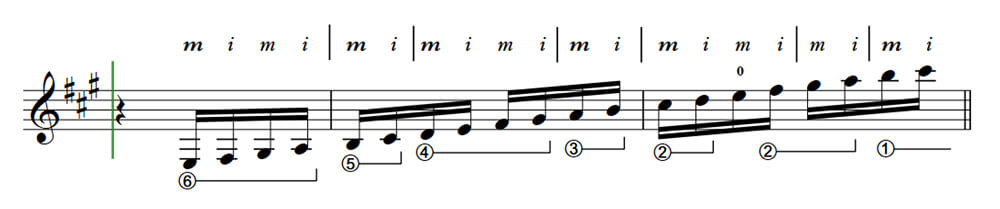
The insight generalises well beyond this piece. Before you finger a fast run, count the notes on each string. If a count is odd, ask whether a different position, string choice or open string can make it even. That one question resolves a surprising number of passages that have felt permanently unreliable.
Fragment, then loop
Arango drills every example the same way, and the method is as much a part of the system as the fingering.
- Break the scale into small fragments, starting from the pickup note where there is one — the upbeat belongs to the fragment, not before it.
- Lock each fragment in at tempo — not at a slow tempo you plan to raise later, but at the tempo it will be played.
- Combine. Groups of four become groups of eight, then the whole run.
- Loop it — and shape it while you loop. The loop is where you work on direction and dynamics, not where you repeat flatly. He drills the Villa-Lobos study this way at a quarter note of 160.
This pairs with an engineered fingering rather than replacing one. Fragments combine cleanly only if the joins between them are mechanically identical to their insides; a fingering with crossings scattered through it has joins harder than the fragments, so the assembly step never quite works. Fix the fingering first.
{{trip-wire}}
5. Inestal's criterion — positive and negative string changes
Quick answer: Eduardo Inestal names the two kinds of string change — positive and negative — and gives a test for telling them apart: one direction of travel wants the longer middle finger to make the change, the other wants the shorter index. He also engineers open strings to land exactly at position shifts, buying time, legato and a moment to breathe.
Arango explains the geometry. Inestal gives it names, and names make it usable. In the final lesson of his Fundamental to Advanced Scale Techniques course, he splits every string change into two categories: a positive change, which runs with the hand's natural alignment, and a negative change, which runs against it. The first is comfortable and reliable. The second introduces a micro-hesitation you can hear.
His rule turns on finger length and direction of travel: going one way you make the change with the longest finger available — the middle; going the other way, with the shorter index. That is the whole criterion. The fastest way to apply it is empirical: finger the crossing both ways slowly, four or five times each, and listen for which one hitches. The awkward one announces itself.
What makes this more than a diagnosis is where Inestal takes it. The right hand's experience is decided by the left hand's choices. His worked example is a C major scale in second position. With the G on the third string stopped by the fourth finger, the run contains a negative change — he can play it, he says, but it does not interest him. Take the same G on the open third string and the negative change disappears; the scale collapses into a clean chain of middle–index, middle–index, and, in his phrase, the problematic is already gone. Same notes, same tempo, different right-hand experience — and the only change was a left-hand decision.
Open strings at the shift moment
The same trick solves a different problem. In multi-octave scales, shifts are the other place the sound breaks: the hand has to travel, and while it travels either the legato dies or the rhythm hiccups. Inestal's fix is to engineer the fingering so an open string falls exactly at the shift.
The open string buys three things at once — time for the hand to relocate, continuous sound while it does, and a moment of release. His example is a D major scale moving from second position to seventh, with the open first string covering the move.
💬 "It could be convenient for me if I use the first string open, so I have a little bit more of time. I can breathe and continue the scale." — Eduardo Inestal
He offers it as one option, not a rule — "it's one possibility," in his words, and "you have to choose." His own reasoning is worth quoting whole: "Can I play it without open string? Yes. Can I play with an open string? Yes. What is better for me? What do I prefer?" He expects you to ask that about your own hand rather than inherit his answer.
That is also where his framing of speed sits. Scales, he argues, are not a display event. "We have always to serve music. It's not about us. It's about the music" — speed is a tool for playing what is written, not a goal in itself. Applied to fingering that is practical, not pious: the right fingering delivers the phrase you want, not the highest metronome number.
6. Kuropaczewski's five methods — and the cage
Quick answer: Łukasz Kuropaczewski attacks scale instability from the opposite end: instead of routing around string crossings, he constrains the right hand until crossings stop costing anything. His Guitar Technique Booster stacks five methods — full planting, a thumb anchor, a following thumb, the ring finger as a barrier, and the two combined into what he calls the cage.
Every system so far routes around the crossings. Kuropaczewski, in his Guitar Technique Booster, does the complementary thing: he accepts them and rebuilds the hand, on the theory that a hand that barely moves has little to go wrong when it changes strings. His framing sets the tone: "Not the speed, the precision of every movement and the control of intensity of every single note of the scale. So you treat a scale as a phrase, not as a scale."
He runs all five on an A major scale across all six strings, metronome at 60 — slow enough that the exercises are about control, not endurance.
Method 1 — plant everything, and think one note ahead
The baseline. Play slowly, planting each right-hand finger on its string before the stroke, so no finger is travelling and striking in one motion. Meanwhile the left hand works ahead: while one note rings, the next left-hand finger is already hovering at its fret. Both hands learn the same habit — arrive early, then play.
Method 2 — anchor the thumb on the sixth string
Plant p on the sixth string and leave it there for the whole scale, playing everything with index–middle alternation. On the basses this is comfortable; as the scale climbs to the trebles the spread gets wide and awkward — and that is the point. The shape occurs constantly in repertoire, whenever a fast melodic line sits above a sustained bass — you are training a position you will actually need.
Method 3 — the following thumb
The opposite constraint: the thumb tracks the playing fingers, always one string below. On the fifth string it sits on the sixth; on the fourth, the fifth; on the second, the third. For short, fast phrases the proximity gives, in his words, far more control of intensity, direction and attachment.
Method 4 — the ring finger as a barrier
Now plant a on the string above where index and middle are working. The ring finger never plays. Its only job is to stop the two working fingers making excessive movements — it "doesn't let the other two just go too wild." It is uncomfortable by design, and he is unapologetic: "If you only want to be in your comfort zone, then you will never play great."
Method 5 — the cage
Combine the two anchors: thumb planted on the string below, ring finger on the string above, index and middle working in the narrow channel between. His favourite scale exercise in the course.
💬 "The first and second fingers feel like it's inside the cage, really, because it's surrounded by these two fingers that are planting the strings." — Łukasz Kuropaczewski
Two caveats. First, these are exercises, not performance positions — which matters, because Matt Palmer explicitly discourages planting the thumb on the sixth string while playing scales on the trebles, on the grounds that it changes the finger approach angle on every string. Both are right about different things: Kuropaczewski introduces a difficulty to train through; Palmer describes what he wants when the music is being played.
Second, his speed protocol. After the slow prepared work, raise the metronome in small steps — 60, 65, 70, 75 — until you reach the edge of what you control, write that number down, and return to slow practice. Expect five to ten points a week. Keep the target in perspective: sixteenth notes at a quarter of 130 to 140, he says, cover 95% of the classical guitar repertoire, and you should be able to play 140 in order to feel comfortable at 130. Never play at the edge of your possibilities.
7. Choosing your system — and when to change it
Quick answer: Matt Palmer's three-notes-per-string a-m-i system trades relearning your scale shapes for one motor pattern that works in every key. Ali Arango keeps standard groupings and routes the fingers instead, placing any unavoidable crossing in the bass strings for tonal reasons. Both are defensible — and Arango's own re-fingering of Villa-Lobos's Étude No. 7 shows the choice is revisable.
Palmer's answer: one pattern for everything
Matt Palmer's On A-M-I Scales takes the most radical position available. Rather than solving each passage, he changes the raw material so the problem cannot arise: a three-notes-per-string left hand paired with a right hand that always runs ring, middle, index, always toward the thumb. Standard fingerings — the two-octave C major most players learn first included — force crossings inside that pattern. Three notes per string removes them.
The payoff is one motor pattern repeated everywhere. Palmer calls it "physically easy and mentally easy," and the efficiency claim is specific: "much of the efficiency of a-m-i comes from these three fingers being on just one plane — the plane of the string — and firing from there." Reaching back or forward with any of them breaks it. A continuously moving arm arrives above the next string group before the fingers do; the left hand shifts weight from finger to finger rather than lifting and replacing.
💬 "My fingers are still really touching the string, but there's no pressure here — so this is what I mean by playing light. Light is fast." — Matt Palmer
The cost: you relearn your scales as three-note-per-string shapes across all seven modes, and they will not match the fingerings printed in most classical editions. A system for players willing to rebuild rather than patch.
Where to put the crossings you cannot avoid
Arango's contrasting answer keeps the standard groupings and routes the fingers through them — and when a crossing cannot be removed, he has a rule for where to put it. Outside flamenco or overtly Spanish writing, put it in the bass strings.
The reasoning is tonal, not mechanical. On the basses you already play with the nail fully forward, so the position a crossing demands costs nothing new. On the trebles you want a rounder sound with more nail angle, so forcing the nail forward fights the tone even if the crossing itself felt comfortable. A crossing is never free — it is cheapest where it damages the sound least.
When to change your mind: Étude No. 7
The best argument that fingerings are revisable comes from Arango revising one of his own — the scale in Villa-Lobos's Étude No. 7, as he teaches it in On Fast Scales.
For years he played the run with three fingers: starting on the middle, an index–middle pair, then three-note a-m-i groups, dropping back to index–middle only once the line reached the sixth string. Fast, but hard to balance — the evenness problem that dogs three-finger scales when the nails are not perfectly matched.
Later he re-fingered the left hand entirely and switched to two. The revision starts on the second string with the index, in groups of four and then two, keeping exactly one deliberate crossing as a stated exception. His reasoning is musical: four notes played with two fingers give a clean four-note impulse, whereas fingering four with three fingers risks an accent landing every third note — "changing the initial intention of the scale." He gave up speed to get the phrasing right.
How to actually choose
Run a passage through these questions in order and stop at the first one that solves it.
- Can the crossing be avoided entirely? A different position, or a different string for one note, often deletes it — always the cheapest fix.
- If not, which direction is it? Use Inestal's test — finger it both ways, listen for the hitch, keep the one that does not.
- Are the note groups even? Count the notes per string. Even groups keep the same right-hand entry finger and stop the pattern flipping on you.
- Is there an open string at the shift? If a position change is losing legato, look for one that can cover the move.
- Where do the accents land? A grouping that fights the metre is the wrong grouping, however comfortable it feels.
- Only then, tempo. If the fingering is right and it is still not fast, that is a practice problem — and the fragment-and-loop method is the tool.
If you are still working out where the notes sit, start with fretboard geography — Bokyung Byun's Fretboard Geography: One Octave Major Scales covers the one-octave patterns that make everything above make sense.
And keep Arango's example in view. He changed a fingering he had performed for years because he decided it was accenting the wrong notes. Your fingerings are not verdicts either — they are the best solution you have found so far.
Frequently asked questions
Is there one correct fingering for a classical guitar scale?
No. The same pitches are available in several places on the fretboard, so any scale has multiple legitimate fingerings, each with real technical and musical consequences. Eduardo Inestal makes this the foundation of his approach to fingering — there is no absolute truth, only many possibilities. The useful question is not which fingering is correct but which constraints you are choosing to prioritise: avoiding string crossings, covering a position shift, or placing accents where the music wants them.
Should I use i-m or a-m-i for fast scales?
Both work, and the choice is a trade. Three-finger a-m-i buys speed because a longer interval passes before any finger repeats, but the sound is much harder to balance, especially if your nails are not perfectly even. Ali Arango uses both and switched a Villa-Lobos passage from three fingers back to two, because a group of four played with three fingers puts an accent every third note. Matt Palmer builds an entire system around a-m-i with three notes per string.
What is a negative string change?
A negative string change is one that runs against the natural alignment of the right hand — the crossing direction where the fingers have to pass each other rather than following the hand's incline. Eduardo Inestal named the pair: positive changes are comfortable and fluid, negative ones introduce a small hesitation you can hear. His rule turns on finger length: one direction of travel wants the longer middle finger to make the change, the other wants the shorter index.
Why do my scales get uneven when I change strings?
Because the unevenness is geometric, not a speed problem. Ali Arango explains that the middle finger is longer and sits nearer the basses while the index is shorter and sits nearer the trebles, and the classical hand position is inclined — so one direction of string change forces the fingers to cross. The stroke itself is fine; what breaks is the preparation. More metronome work does not fix it. Re-fingering, or constraining the hand, does.
Should I anchor my thumb on the sixth string while playing scales?
As an exercise, yes; as a performance habit, no. Łukasz Kuropaczewski plants the thumb on the sixth string deliberately to make the hand uncomfortable on the trebles, because that wide spread mirrors repertoire where a fast line sits over a bass. Matt Palmer discourages the same anchor while actually playing, because it changes the approach angle of the fingers on every string. Both are right about different things.
Do I have to learn three-notes-per-string scales?
No, but they are required if you want Matt Palmer's a-m-i system. Standard scale fingerings, including the common two-octave C major, force crossings inside the a-m-i pattern; three notes per string removes them and gives you one motor pattern for every key. The cost is relearning your scale shapes across all seven modes, and accepting that they will not match the fingerings printed in most classical editions.
How do I stop position shifts from breaking the legato in a scale?
Engineer an open string to land at the shift. Eduardo Inestal arranges his fingerings so that an open string falls exactly where the hand has to travel — his example is a D major scale moving from second to seventh position, covered by the open first string. The open string buys three things simultaneously: time for the hand to relocate, continuous sound while it does, and a moment of release. He treats it as one option, not a law.
How fast do my scales actually need to be?
Less fast than you think. Łukasz Kuropaczewski's number is sixteenth notes at a quarter of 130 to 140, which he says covers 95% of the classical guitar repertoire — and he adds that you should be able to play 140 in order to feel comfortable at 130, because you should never play at the edge of your possibilities. Eduardo Inestal makes the same point differently: speed is a tool for serving the music, not a goal.
Next steps
Back to the hub: Classical Guitar Scales: The Complete Guide
- The Segovia Scale System for Classical Guitar — where the standard printed fingerings came from, and how to read them as territory rather than as a route.
- Classical Guitar Scales for Beginners — start here if strict alternation and your first transposable patterns are still being built.
- Making Classical Guitar Scales Fun — rhythmic and musical variations that keep a scale routine alive.
- How to Play Fast on Classical Guitar — the speed side of the same problem, from the Technique cluster.
Engineer your own fingerings
Every system in this article comes from a full lesson on tonebase, taught by the guitarist who built it — Ali Arango on fast scales, Eduardo Inestal on finding fingerings, Łukasz Kuropaczewski on right-hand stability, Matt Palmer on a-m-i. They sit alongside 700+ masterclasses from the world's leading classical guitarists, with a free 14-day trial to work through them at your own pace.


