



Table of Contents
- What a scale is on the guitar — and why one string won't do
- Before your first scale — the two prerequisites
- The right hand — strict alternation
- The left hand — minimum pressure, fingers close
- Putting the hands together — synchronization before speed
- Your first real scales — C major, G major, and your first pattern
- A beginner's scale routine — ten minutes, every other day
1. What a scale is on the guitar — and why one string won't do
Quick answer: A scale is a collection of pitches ordered in ascending or descending motion, built from a fixed sequence of whole and half steps. Mircea Gogoncea shows that playing one along a single guitar string works in theory but drags the left hand up the neck. Covers the formula, string groups, and why guitar scales are a two-hand problem.
Start with the definition. It is smaller than most beginners expect. Bokyung Byun opens her Fretboard Geography course by calling scales "a collection of pitches ordered in ascending or descending motion." Eduardo Inestal begins his scale course with almost the same words: "a group of notes that are arranged by ascending or descending order of pitch." A scale is an ordering, not a technique.
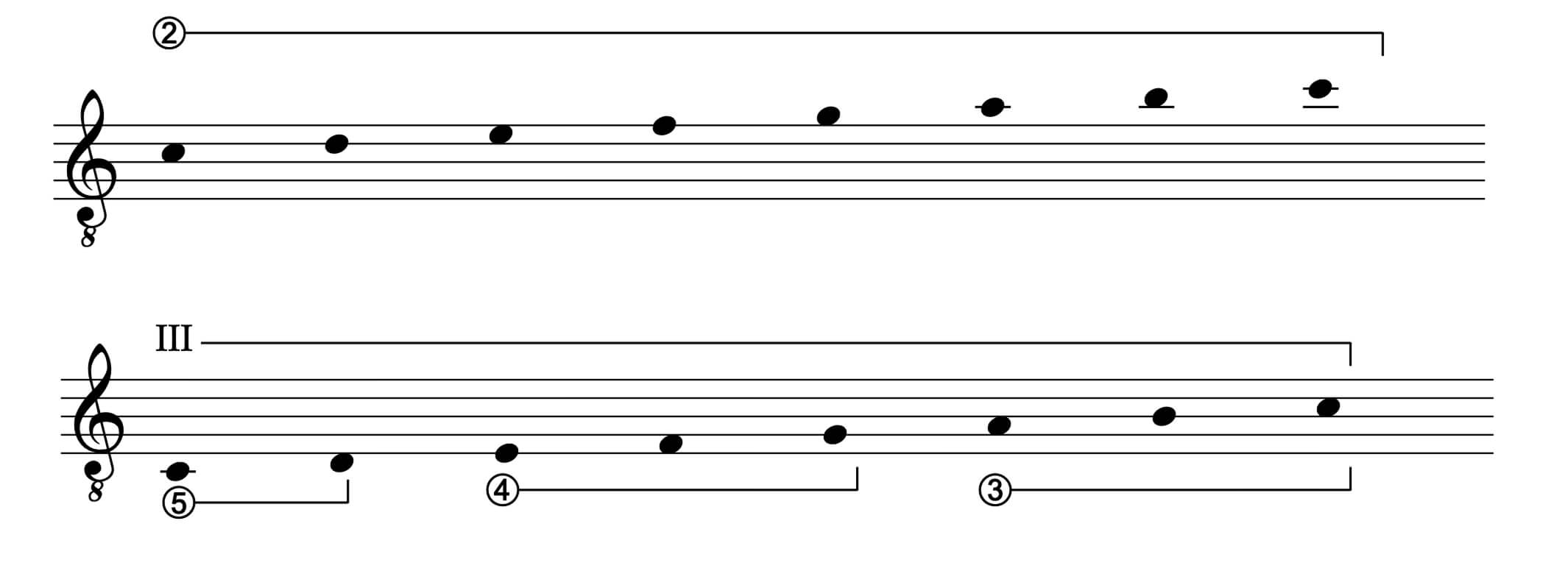
What turns that ordering into a major scale is a fixed sequence of distances: whole, whole, half, whole, whole, whole, half. On the guitar the frets do the measuring for you: a half step is one fret, a whole step is two. Play that sequence from any starting note and you have the major scale that belongs to it.
So why not just play it on one string? You can. Mircea Gogoncea does exactly that in Guitar: Major Scale, starting from C on the first fret of the second string. Then he names the problem: "this is actually quite impractical for us as it requires your left hand to move around the fretboard quite a bit." Byun reaches the same verdict in One Octave Major Scales Intro.
💬 "Playing scales on a single string is really impractical, and that's why most musical exercises and passages involving scales use several strings to play them." — Bokyung Byun
The alternative — the one every classical guitarist actually uses — is to spread the same eight notes across three or four adjacent strings so the left hand can stay in one place. That single decision is what makes guitar scales hard. On piano, a scale is a finger problem in one hand. On guitar, it is a coordination problem across two. As Inestal puts it at the top of Getting Started with Scales, scales usually involve more fingers and several strings.
2. Before your first scale — the two prerequisites
Quick answer: Two things come before any scale: a stable playing position and genuine relaxation. Eduardo Inestal names both in the first minute of his scale course and removes speed from the goal list, while Vladimir Gorbach builds a warm-up that trains release rather than velocity. Covers position, relaxation, and the play-relax-plant cycle.
Inestal spends the opening of Getting Started with Scales on two things, and neither is a note. The first is position: sit properly, and have the guitar "properly in touch with our body." The second is relaxation — "be completely relaxed or as relaxed as possible" — and he extends the check well past the hands, to the fingers, the shoulders, the arms, the whole body, "because the minimum tension is going to have an impact on your technique, an impact on your playing."
Then he removes the thing most beginners came for. "Speed is going to be a consequence of relaxation and it's going to come by itself. It's not a goal that we have to seek." Read that as a claim about mechanics, not reassurance. A finger that has already tightened cannot move quickly, and a finger you cannot release on command cannot prepare the next note.
Vladimir Gorbach makes the same argument from the other end. He opens On Scales by saying the philosophy behind practicing scales is "first aimed at not practicing speed, but really practicing control." The fast part, he argues, you already have.
💬 "We all have a natural ability to play fast, actually, and move our fingers fast, but it's timing that we need to learn." — Vladimir Gorbach
His warm-up trains exactly the missing half. Set a metronome to 60 and play on every second beat, with one finger — index, on the third string. Each cycle has three parts. Play the note. Relax immediately, dropping all tension; the finger may bounce back slightly, and that is individual. Plant it back lightly on the string to prepare the next attack. The release is not vague: Gorbach puts it exactly halfway between the notes — "the safest way to do this is right in the middle." At that tempo there is time to check the shoulders and forearms too, which is the point of starting there.
3. The right hand — strict alternation
Quick answer: Scales are played by alternating index and middle, never repeating a finger. Eduardo Inestal calls it a walking movement: while one finger is inside the palm the other is already out, ready. Covers the walking motion, the first open-string exercise, and free stroke versus rest stroke.
Before the left hand touches anything, Inestal fixes two right-hand ideas. The first is the walking movement. When i is inside the palm after playing, m must already be out, waiting over the string. Let both curl in at once and there is a gap: "it's going to take time to bring the other finger out, and then we're going to be slow."
The second is strict alternation. Never play two notes in a row with the same finger.
💬 "If you repeat one finger, you are going to be slow. It's like walking and then you take two steps with the same leg. It doesn't work." — Eduardo Inestal
You can hobble through a passage with repeated fingers. It will just be slower and less reliable than the same passage alternated — forever.
The open-string exercise
Inestal's first scale exercise has no scale in it. Pick the second or third string and play it open, alternating i and m, slowly. The left hand does nothing. The goals are narrow on purpose: the same quality of sound from both fingers, and the same volume. "I don't want one finger to play louder than the other one."
Most beginners fail this test without finding out, because they add the left hand first. Play sixteen notes on one string and listen for whether every second note is quieter. That unevenness is already in every scale you will ever play. Fix it here, where there is only one variable.
When one string is even, use two: four notes on one string, four on the next, back again. "We have to have the control of our fingers on the sound before we increase the speed."
Free stroke and rest stroke — practice both
In rest stroke (apoyando) the finger comes to rest against the next string after sounding the note. In free stroke (tirando) it clears that string and travels into the palm. Inestal is unambiguous: every exercise gets done both ways, and the walking movement is identical in each. Beginners adopt one and abandon the other. Don't — the repertoire demands both.
{{trip-wire}}
4. The left hand — minimum pressure, fingers close
Quick answer: The left hand's job is to change notes with the least motion and the least force that still gives a clean tone. Eduardo Inestal builds this with two- and three-finger combinations on one string, keeping an anchor finger down. Covers finger combinations, economy of movement, anchoring, and the tension test.
Inestal's left-hand work starts as small as the right-hand work did. Put fingers 1 and 2 on the same string — the fifth fret of the fifth string works — and alternate between them while the right hand keeps its walking motion. Then work through every pair: 1-2, 1-3, 1-4, 2-3, 2-4, 3-4. Then the three-finger sets: 1-2-3, 1-2-4, 1-3-4, 2-3-4. Between those two exercises, he says, "you have everything pretty much when you play scales."
The governing principle is economy of movement. "The less movement you do with your hands with both, actually, the better. Because you are going to increase accuracy, you are going to reduce time of playing." Inestal's summary is deliberately unheroic: "Try to be as lazy as possible. Move yourself as less as possible."
Economy also means leaving fingers down. In a 1-2 combination, finger 1 stays on the string while 2 does the work: "I have one finger fixed that's going to give me stability." An anchored finger is a reference point — the hand stops re-finding its place on every note.
Pressure is the other half, and it is invisible until you test for it. Fret a note, release until it buzzes, then add back the smallest amount that clears the buzz. That is the pressure the note needs. Most beginners use several times more, and the cost is a left hand that fatigues in ninety seconds.
Inestal's tension diagnostic: a finger sticking out stiffly, straightened away from the fingerboard, is a sign of tension. The correction is to reduce it and stay "as close as possible to the strings and the fret" — not to press harder.
One more permission, from Daniel De Arakal: if a two-fret jump like F to G strains the hand, move the hand. "Small shifts are totally acceptable. I would rather have that small shift occur than having to have an unnecessary reach between these two notes."
5. Putting the hands together — synchronization before speed
Quick answer: A scale sounds clean only when the left-hand finger arrives at the exact instant the right-hand finger plucks. Eduardo Inestal treats that synchronization as the most important thing in scale playing. Covers what mistimings sound like, eyes-closed practice, and the first chromatic scale.
Everything so far has been one hand at a time. The moment they meet, a new failure mode appears.
💬 "Synchronization is key between these both hands. Try to move your fingers exactly at the same time." — Eduardo Inestal
Inestal diagnoses the two failures in Exploring Scales on Multiple Strings. If the right-hand finger arrives early, the note clips and the line turns staccato. If the left-hand finger lands early, it sounds the note by itself and you get an unintended slur. When the two are merely close rather than together, it just sounds grainy.
Practice it on the smallest possible unit: fingers 1 and 2 on one string, right hand alternating, one question only — did those two events happen at the same instant?
Practice with your eyes closed
You cannot watch both hands at once, and once you are reading music you will not be watching either. Inestal's fix is to stop relying on sight: "it's very important as well to play these exercises with your eyes closed in order to feel" whether a finger is tense or relaxed. Feeling catches the tension your eyes miss, and it is the sense still available with a score in front of you.
Your first chromatic scale
Put all four left-hand fingers in sequence on one string — 1, 2, 3, 4 — and you have a chromatic scale, which, as Inestal notes, "also happens to be in our repertoire."
Start it high on the neck, not at the nut. Inestal recommends beginning "at least from the fifth fret, because the position of our finger is going to be more relaxed." In Scales Over Multiple Positions he lines them up: at the ninth and fifth frets the fingers are "packed together," while first position forces the hand to expand — "natural tension that we cannot avoid, but you have to pay attention not to have extra tension." Learn the pattern where it is comfortable; carry it down once it is secure.
6. Your first real scales — C major, G major, and your first pattern
Quick answer: The first scales worth learning are C major and G major in first position, taught by Daniel De Arakal as note-reading exercises rather than technical drills. Bokyung Byun's transposable one-octave patterns come next. Covers first position, both scales, and the 2-3-3 and 3-3-2 patterns.
De Arakal's beginner course reaches its first scale in lesson six, and the framing matters: the scale exists to teach you where the notes are. First position is defined precisely: "the first finger is responsible for the first fret, second finger for the second fret, et cetera."
C major first. Notes on the First & Second Strings ends with a five-note fragment — C, D, E, F, G — running from the first fret of the second string to the third fret of the first. De Arakal flags the right-hand consequence of your first string crossing: "watch my right hand on this one. To accommodate the string crossing that occurs, I'm going to start with the middle finger." Start on i instead and you arrive needing the same finger twice.
G major second. In Notes on the Fifth & Sixth Strings the scale runs from the third-finger G on the sixth string up to the open fourth-string D — new because it begins on a fretted note and ends on an open one. It also adds the habit that beats any drill: play every note in first position, lowest E to highest G, "saying the names of the notes out loud."
Two later lessons extend the same scales. In Shorter Rhythms you play both in quarter notes and then eighths at the same tempo — proof that denser subdivision is not a faster pulse. In Accidentals & Key Signatures, G major returns under its key signature, one sharp, so every F becomes F♯.
Your first transposable pattern
Byun's 2-3-3 Patterns spreads a one-octave major scale over three adjacent strings — two notes on the starting string, three on the next, three on the highest, all in one hand position. 3-3-2 Patterns exists because certain keys push that shape too high up the neck; three notes go on the starting string instead, at the cost of "a bit more stretching and contracting of the left-hand fingers."
The payoff is transposition: move a shape up one fret and you get the same scale in a new key — "you can transpose anything up and down as necessary without changing the shape of your left hand," as Gogoncea puts it. Byun's warning is the one to take seriously: "don't just memorize the patterns." Say the pitches aloud while you play.
7. A beginner's scale routine — ten minutes, every other day
Quick answer: Vladimir Gorbach recommends five minutes of warm-up plus ten to fifteen minutes of scales, every other day, with regularity mattering more than intensity. For a beginner that becomes a ten-minute block on alternating days. Covers the routine, what to add and when, and how to tell you are ready.
Gorbach ends On Scales with the part that decides whether any of it works: "you could do five minutes for setup and 10, 15 minutes for the scale portion of it every other day. But make sure you do it regularly."
Every other day is deliberate: the day off is when the previous session consolidates. Here it is at beginner scale.
The ten-minute block
- Two minutes — open-string alternation. Metronome at 60, playing on every second beat: one finger, then alternating i and m. Play, relax in the middle of the gap, plant. One minute free stroke, one rest stroke.
- Two minutes — one left-hand combination. A single pair (1-2 on Monday, 1-3 on Wednesday) on one string, right hand still alternating. Last thirty seconds eyes closed.
- Three minutes — one scale. C major, then G major, at 60 with one note per beat. The only question: do the hands land together?
- Two minutes — name the notes. Play the same scale again, saying each pitch aloud — the fastest fretboard-learning tool there is.
- One minute — recalibrate. Drop below any tempo you used all session — to remind yourself "how nice it feels to relax and always be in control."
💬 "Guitar rewards comfort and relaxation. Find the tempo that's comfortable for you and proceed from there." — Daniel De Arakal
What to add, and when
Add one thing at a time, and only when the current version is boring. After roughly four weeks: eighth notes at the same metronome mark, the remaining two-finger combinations, the chromatic scale at the fifth fret, one Byun pattern in a couple of keys. Metronome ladders come last — Gorbach runs 60, 80 and 100 at one note per beat before two notes per beat appear.
How to know you're ready for more
Four signals, all checkable in one session: both right-hand fingers produce the same volume; there is no bump at a string crossing; your left hand is not tired after ten minutes; you can play with your eyes closed without losing the pulse. When all four are true: two-octave scales with shifts, a fingering system, the Segovia set.
If they are not all true yet, the fix is never a faster tempo. It is a slower one.
Frequently asked questions
What scale should a beginner learn first on classical guitar?
C major, then G major, both in first position. Daniel De Arakal introduces C major as a five-note fragment across the second and first strings, then G major spanning the bass strings, teaching both as note-reading exercises rather than drills. That order works because C major has no sharps or flats and stays in one small area, while G major adds a fretted starting note and a second string crossing. Learn the notes before the pattern.
How long should a beginner practice scales each day?
Ten minutes, every other day, is enough to make real progress. Vladimir Gorbach recommends five minutes of warm-up plus ten to fifteen minutes of scales on alternating days, and stresses that regularity matters more than duration. A beginner can compress that into one ten-minute block: open-string alternation, one left-hand combination, one scale, and a minute of naming notes aloud. Longer sessions early on add tension rather than skill.
Do I need to use rest stroke for scales, or is free stroke fine?
Both, from the beginning. Eduardo Inestal has students practice every scale exercise twice — once tirando (free stroke) and once apoyando (rest stroke) — because the walking motion and the alternation rule are identical in each. Rest stroke gives a fuller, more projected tone and is traditional for scale passages; free stroke is what you need when other voices sound underneath. Dropping one leaves a hole you will have to fill later anyway.
Why do my scales sound uneven?
Almost always because one right-hand finger is louder than the other, or because the hands are not landing together. Test the first on an open string: alternate index and middle for sixteen notes and listen for whether every second note is quieter. Inestal treats equal tone and equal intensity as the very first goal, before the left hand is involved. If the tone is even and the scale still sounds lumpy, the problem is synchronization.
Should I use a metronome when I first start practicing scales?
Yes, but slowly and for stability rather than speed. Gorbach starts his own scale work at 60 BPM playing on every second beat, which leaves an enormous gap between notes — the gap is the exercise, because that is where the finger relaxes and replants. At that tempo it also exposes hesitation at string crossings you would not otherwise hear. What it is not for yet is a weekly climb in BPM.
My left hand gets tired or cramps when I practice scales. What am I doing wrong?
Too much pressure, too much finger movement, or both. Fret a note, ease off until it buzzes, then add back just enough to clear it — that is the pressure the note needs, and it is far less than most beginners use. Inestal's second correction is proximity: keep the fingers close to the strings and frets instead of lifting them away, and leave an anchor finger down. If a stretch still strains, De Arakal permits a small shift of the whole hand.
Do I have to learn to read music to practice scales?
No, but the two reinforce each other so strongly that separating them is a waste. De Arakal teaches scales specifically as vehicles for locating written notes on the fretboard, and Bokyung Byun asks students to say each pitch aloud — in letters, solfège, or scale degrees — while playing. Byun is direct about the alternative: don't just memorize the shapes. A pattern you can play but cannot name is a finger habit, not knowledge.
How do I know when I'm ready for two-octave scales and the Segovia scales?
When four things are true: both right-hand fingers sound equally loud, string crossings have no bump, your left hand is not tired after ten minutes, and you can play a one-octave scale with your eyes closed without losing the pulse. Inestal's own sequencing supports this — his first lesson covers everything playable without shifting, and only then introduces position changes. Two-octave scales layer a shifting problem on a coordination problem. Solve the coordination first.
Next steps
Back to the hub: Classical Guitar Scales: The Complete Guide — what scales actually train, and how the pieces fit together.
- The Segovia Scale System, Explained — where the standard scale set came from and how to work with it once one-octave scales are secure.
- Classical Guitar Scale Fingerings: Systems of the Pros — how professional players choose left- and right-hand fingerings, and why there is no single right answer.
- Making Classical Guitar Scales Fun — practical ways to keep a scale routine from becoming a chore.
- Whole and Half Steps — the interval theory underneath the W-W-H-W-W-W-H formula.
Learn scales from the players who use them
Every lesson quoted here is on tonebase, alongside more than 700+ masterclasses from the world's leading classical guitarists — Eduardo Inestal's complete five-part scale pathway, Vladimir Gorbach's practice session with the metronome running, Daniel De Arakal's beginner course from the first open string, and Bokyung Byun's fretboard patterns in all twelve keys. Start with the free 14-day trial and work through them at your own pace.


