Course Syllabus
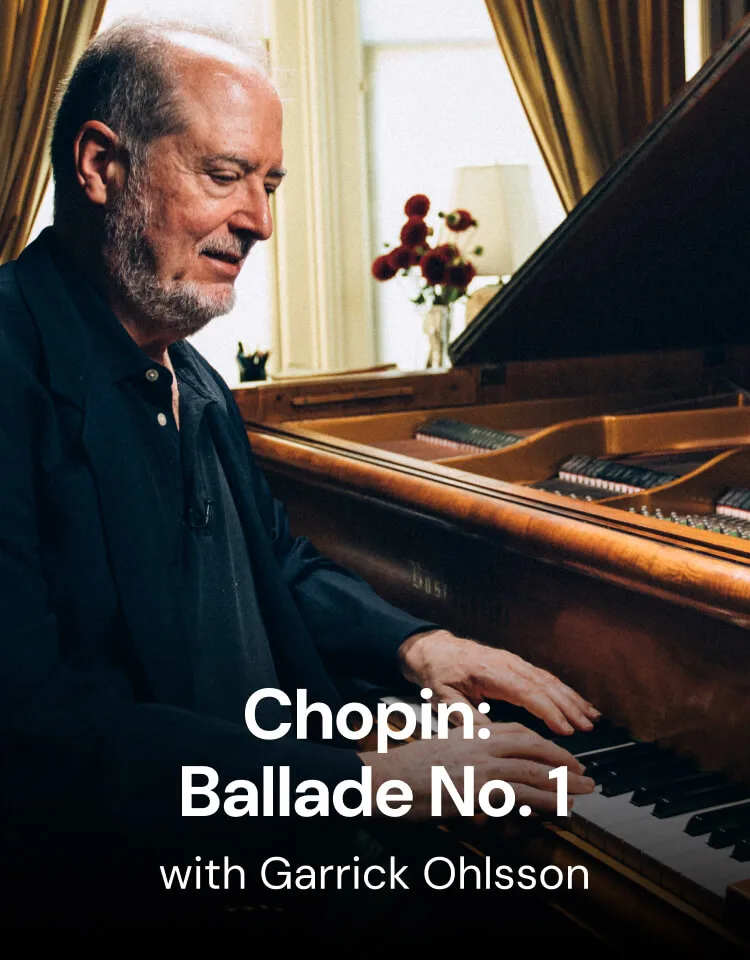
Ballade No. 1 in G Minor, Op. 23
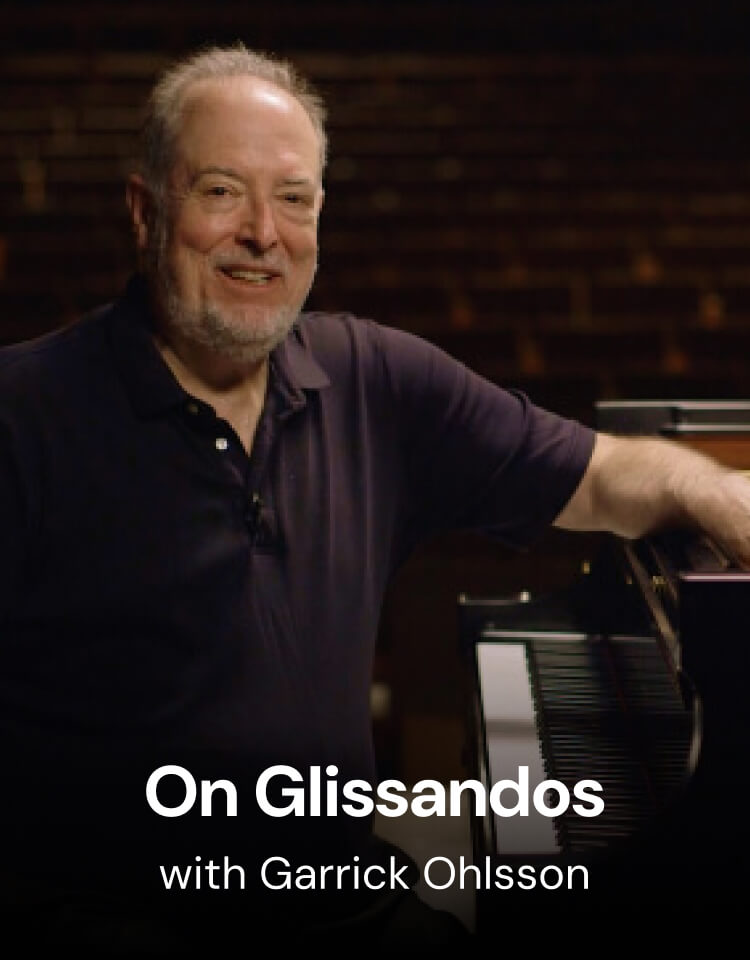
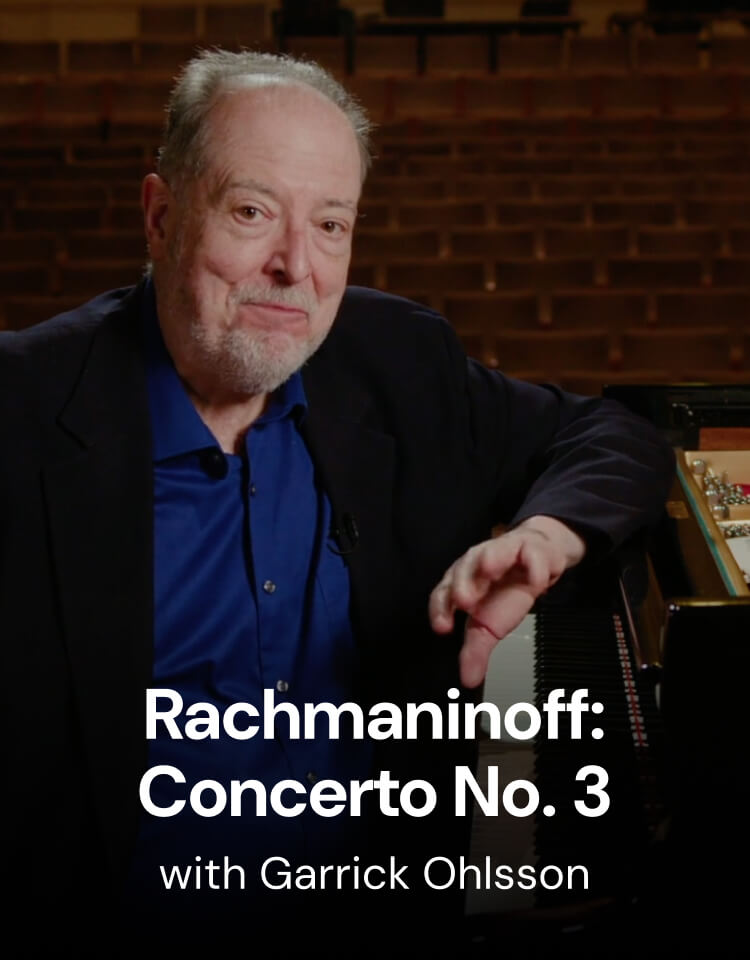
In this lesson, American pianist Garrick Ohlsson takes you through Chopin's G Minor Ballade. "A revolution in its time," according to Ohlsson, the piece is one of the most beloved works of the Romantic period. Ohlsson takes you on a tour of the work, revealing the miracle Chopin performs in each and every passage.
Dedicating considerable time to the introduction of the Ballade, Ohlsson analyzes the harmonic ambiguities that give the iconic opening phrase its special character. The work tells a musical story, Ohlsson stresses, and the choices you make about phrasing and rubato will influence the kind of story you're telling. Balancing Chopin's textures is also important, and Ohlsson gives advice on how to achieve a singing, bel canto line in the right hand while carefully applying pedal to layer the harmonic and contrapuntal elements in the lower registers.
As the story unfolds, there are multiple climactic moments, and the timing and pacing with which you move to and from these peaks will define the arc of the whole work. The journey also brings a series of virtuoso passages, each of which Ohlsson analyzes for the most important rhythmic and tonal elements that can aid in execution.
The coda of the work, feared by so many pianists, is the focus of the last part of Ohlsson's lesson. He breaks down the right hand's technical obstacles into its simplest elements, and offers practice advice for building the passage up slowly and comfortably.
Etude Op. 10 No. 1 in C Major
In this lesson, American pianist Garrick Ohlsson examines the biomechanics of Chopin’s First Étude in meticulous detail. Concentrating on the first couple bars, Ohlsson demonstrates methodically how to choreograph the hands to execute the first pattern. If you can learn to practice the opening, you will know how to practice the whole piece.
Ohlsson admits that there are spots that are particularly “diabolical." To master them, you must develop a technique he calls "relaxation into the future." Ohlsson stresses the importance of releasing the tension in your hand immediately after striking a note in order to be prepared for the next one. In a piece of music as virtuosic as this, you cannot afford to hang onto notes. Rather, Ohlsson encourages you to focus on the natural expansion and contraction of the hand as a means of traveling across the keyboard with flexibility and fluidity.
Though Ohlsson warns that the piece requires you to “train like an athlete,” the payoff is enduring: “an encyclopedic lifetime” of knowledge about how to use your hands deftly and efficiently.
Scherzo No. 3 in C-sharp Minor, Op. 39
In this lesson, American pianist Garrick Ohlsson guides you through Chopin’s Scherzo, Op. 39, No. 3 in C-sharp Minor.
When you practice the introduction, Ohlsson encourages you to explore playing with different degrees of rubato, since pianists have interpreted this section in numerous different ways, and Chopin does not specify tempo markings.
When you practice the octaves in this piece, Ohlsson suggests using the lateral movement of your thumb to help you to reach wide intervals without needlessly shifting your entire hand position. To find even more comfort, you will learn to cultivate a “relaxation response,” immediately releasing tension in your hand after striking the keyboard.
You will also learn strategies for practicing Chopin’s challenging left-hand jumps. To avoid locking your hands at either end of a jump, Ohlsson teaches you to imagine each jump as a single, fluid gesture in which your arm is constantly oscillating.