Course Syllabus
Sonata in E Minor, Hob. XVI:34 – I. Presto
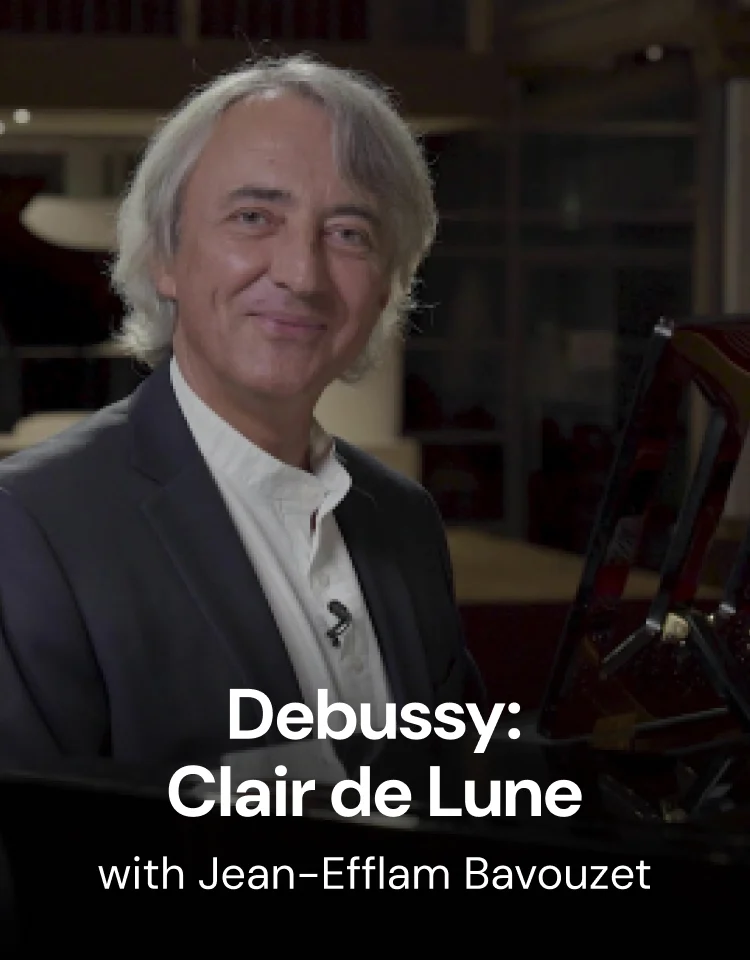
Join celebrated French pianist, Jean-Efflam Bavouzet, as he walks you through the first movement from Haydn's thrilling Sonata in E Minor.
'Presto' is an unusual marking for a sonata first movement, and Bavouzet draws your attention to the interplay between the brisk tempo and recurring pauses in momentum. The many fermatas throughout the first movement offer the opportunity to achieve an element of surprise, a trademark of Haydn's compositional style.
Bavouzet also addresses the economical approach Haydn takes to his material, highlighting the underlying continuity between first and second themes despite their contrasting characters. As a performer, you will need to master a variety of articulations in order to execute the between slurred and staccato motives that pervade this piece. Bavouzet is always ready with fingering and technical advice, and shows how they can support a tasteful interpretation. Most importantly, Bavouzet insists, "be creative" and "never boring."
Finally, Bavouzet shares his arrangement of the first movement coda, arguing based on scholarly evidence that the repeat should be shifted to the end of the recapitulation.
Sonata in E Minor, Hob. XVI:34 – II. Adagio
In the second movement from Haydn's Sonata in E Minor, Jean-Efflam Bavouzet draws your attention to several challenges of interpretation posed by the Adagio.
Bavouzet begins by analyzing the slow harmonic rhythm and reveals how it structures the longer phrase. Paying attention to the longer harmonic trajectory can help to inform articulation in sculpting the larger contour of the section, while longer range dynamic planning can being cohesion to the whole A Section.
The B Section begins with a "miracle," as Bavouzet relishes in Haydn's modulation back to E minor before showing how to apply pedal judiciously in the ensuing fantasia-like passagework. The A Section returns, inviting embellishment, before giving way to a mini-cadenza. The music transitions in the final phrase, and Bavouzet marks this section emphatically as the dramatic peak of the entire sonata.
Sonata in E Minor, Hob. XVI:34 – III. Vivace molto
The third movement of Haydn's Sonata in E Minor, marked 'Vivace molto', is a brief and brisk study in contrast. Bavouzet identifies the form as an unusual hybrid of rondo and variations, and points to the interplay between parallel major and minor tonalities as pivotal to the work's drama.
Bavouzet takes the time to work through the technical obstacles, from controlling and balancing the left hand Alberti bass in the refrain to executing the rapid right-hand repeated notes in the closing phrase.